by Benjamin J.M. Horn
Published January 2026
Download full pdf of article here.
Abstract
This article explores how Baldur’s Gate 3 perpetuates Victorian-era racism and classism through its Act One conflict and in particular the treatment of its goblins. Goblins occupy a curious position in fantasy digital games: ever-present as weak monsters for players to kill for battle experience, they nevertheless straddle the line between monstrosity and humanity, putting them in a similar class to other humanoid monsters such as vampires, werewolves, and zombies. Unlike most popular games, Baldur’s Gate 3 puts the goblins at the heart of its opening act’s conflict. In so doing, as a close reading will demonstrate, the game leans upon classist and racist tropes that have their roots in Victorian England. To perform this analysis, this article surveys the contemporary literature on monstrosity and race before tracing the modern goblin back through Dungeons and Dragons (Gygax & Arneson, 1974), J.R.R. Tolkien’s Middle-earth, and George MacDonald’s influential fairytale novel, The Princess and the Goblin (1872).
Keywords: goblins, racism, classism, monstrosity, Baldur’s Gate 3
Introduction
Deep in the darkness of a ruined temple, my party of adventurers seeks out the Archdruid Halsin, whom we have been told may have the cure for a terrible parasite infecting our minds. After carefully navigating past a group of zealous goblin cultists, we arrive at a small chamber in the ruins where the druid has been imprisoned. Some of the goblins—including three goblin children—are tormenting the druid, now transformed into an enormous and angry bear. To free the druid and to satiate his bloodlust we must kill his jailers—including the children. Once they are dead, the archdruid comes to himself. He quickly informs my party that securing his aid will require the regrettable, but necessary, killing of all the goblins occupying the temple.
This is part of the main story quest in Act One of the acclaimed Baldur’s Gate 3 (Larian Studios, 2023). Baldur’s Gate 3 is a single-player roleplaying game created by Larian Studios in collaboration with Wizards of the Coast, who produce the fantasy tabletop game Dungeons and Dragons (D&D), from which Baldur’s Gate 3 derives its gameplay and setting. It is no exaggeration to say that Baldur’s Gate 3 has had a tremendous reception since its release. On OpenCritic, a review aggregator website, the game has a 98% recommendation rate from critics. This critical response has been matched by a shower of accolades, including game of the year wins at the Golden Joystick Awards, the Game Awards 2023, the Steam Awards, the New York Game Awards, and the 27th Annual DICE Awards. The game has been singled out for its entertaining implementation of the D&D rules in digital form, its progressive cast of characters, and its compelling story (King, 2023).
Given Baldur’s Gate 3’s cultural impact and foreseeable influence over other developers looking to learn from its success, it becomes all the more essential to critically interrogate the game’s design, in particular its creative choices. Freedom of choice in the game is important because it allows the player to take ownership of their story, giving them the power to shape the game world according to their beliefs. Doing so makes the experience of playing Baldur’s Gate 3 a deeply meaningful one that can in turn reshape the way the player understands the real world. Each of the three acts comprises thousands of player-led choices, but just a single major decision. In Act One, this is the decision as to whether one should side with the goblins or the devil-like Tieflings.
Moreover, the choice to kill the goblins is commonly referred to as the “good” path (Bailey, 2023). This sees the player slaughter the goblins with Archdruid Halsin in order to save a group of Tiefling refugees from a fast approaching goblin raid. Alternatively, the player may choose to side with the goblins and participate in the raid, massacring the friendly Tieflings. This is commonly referred to as the “evil” path. Notably, both involve the slaughter of one of the two races – including the murder of innocent children. Yet, one is known as good and the other as evil. Why?
Of course, the answer is deceptively simple: goblins are monsters, low-level monstrous humanoids small in stature with over-large ears and noses. Often green-skinned, goblins fight with daggers and occasionally steal from the player. Many games utilize goblins to provide players with an early combat challenge. Typically these goblins are mindless and cruel, as seen in series like Final Fantasy (Square Enix), Elder Scrolls (Bethesda), or Dragon’s Dogma (Capcom). Yet there are times when they become something more than monsters. In the case of Baldur’s Gate 3’s goblins, when the player arrives at the goblin camp they can be seen joking and cavorting, singing and dancing as they feast together. The goblins will even chat with the player, all of which makes their slaughter that much harder to stomach.
Goblins have long straddled the line between monstrosity and humanity, putting them in a similar class as other almost-human fantasy monsters such as orcs, werewolves, vampires, and zombies. As many others have noted (Trammell, 2018; Švelch, 2023; Ford, 2025), monsters reflect those aspects of humanity which modern society fearfully scorns. This begs the question as to what fear do goblins represent to modern society? Why is killing them in one of the most popular games of the 2020s so easily justified and accepted as the moral thing to do? In this article, I intend to add to the literature around monsters and race in fantasy games by exploring how the goblin has evolved (or devolved) over the course of its long history in the Western cultural imagination, ultimately demonstrating how 19th century Victorian racism and classism provides the logical basis for the pivotal conflict in Act One of Baldur’s Gate 3. In order to do so, I will proceed backward through time, thereby developing the necessary historical context for the subsequent analysis of Baldur’s Gate 3. This is meant to serve as the basis for further research of the goblin as ludic monsters as well as to show how antiquated discriminatory conceptual paradigms can penetrate into otherwise progressive modern fantasy games. By doing so, I hope developers and players may agree that such tropes are outdated and choose to reject them.
Monstrosity, Race, and Dungeons and Dragons
I will begin with a survey of the present day literature on monstrosity and race in fantasy with a focus on games, wherein monsters are particularly commonplace. It should be noted that while overlaps exist between discussions of race in fantasy and monstrosity, they remain distinct. At the same time, as the goblin straddles the line between monstrosity and humanity both discussions are relevant and make a good starting point for tracing the development of the goblin up to its present form in Baldur’s Gate 3.
If goblins are monsters, what are monsters? Jaroslav Švelch (2023), in his book Player vs. Monster, starts with the film scholar and horror theorist Noël Carroll’s (1990) definition of a monster as “any being not believed to exist now according to contemporary science” (p. 27), with Švelch adding that monsters are “nonhuman fantastic beings” (p. 3). I follow Švelch’s definition, as goblins fit comfortably within this purview. But the issue extends beyond a lack of humanity. Jeffrey Jerome Cohen (1996) argues that the monster is “pure culture . . . like a letter on the page, the monster signifies something other than itself: it is always a displacement” (p. 4). Monsters are fictional manifestations of our real fear of that which is different.
In the introduction to their book Monstrosity in Games and Play (2025), Sarah Stang et al. identify Bernard Perron’s (2009) Horror Video Games: Essays on the Fusion of Fear and Play as foundational for the study of monsters in the context of games, highlighting how Perron “observes that confrontation with the monsters is inevitable in many games because the player is forced to either flee or kill it in order to proceed further” (p. 9), which is exactly the case in Baldur’s Gate 3. Švelch makes a similar point, noting that ludic monsters “embody a specific kind of computational and commodified otherness that is designed to be confronted and defeated” (p. 5). In short, the ludic monster is a complex cultural assemblage, one which players are forced to face and overcome.
One non-digital game that has generated significant discussion with respect to its monsters and races is Dungeons and Dragons, the tabletop RPG on which Baldur’s Gate 3 is directly based and from which the representation of the goblin derives. D&D emerged in the late 20th century, inspired by J.R.R. Tolkien’s The Lord of the Rings and tabletop model war-gaming (Peterson, 2012). While originally something of a niche hobby, D&D has grown tremendously in popularity since the release of its 5th edition rule set (Schmidt, 2019; Diamond, 2022; Beazley and Touma, 2024).
In D&D players take on the role of a party of adventurers exploring fantastical lands, battling monsters, and plundering treasure along the way. Another player, termed the Dungeon Master (“DM”), is tasked with presenting a free-form story that the others interact with through their in-game avatars and by rolling dice to determine the outcome of actions. Before beginning, the players who are acting in the game as adventurers create their own unique characters in accordance with the rules of the game, traditionally found in the Player’s Handbook (Mearls and Crawford, 2014).
When designing a character, players are given a spreadsheet of available choices. The most important decision from a gameplay perspective is undoubtedly that of class, which determines the player’s capabilities inside and outside of combat. Close behind this choice, at least until the most recent edition, was the selection of one’s race. Players could choose from a list of fantasy humanoids each with their own powerful racial abilities. Tellingly, in the most recent 2024 update to the game players no longer choose a race but rather a species. In the handbook there is no longer a chapter dedicated to race, but rather a chapter called “Origins,” which includes both species and backgrounds for players to select from.
Much has been written about D&D and the problematic logic underlying its complex system of rules. Christopher Warnes (2005), for instance, in a paper discussing Baldur’s Gate I (BioWare, 1998) and Baldur’s Gate II (BioWare, 2000), notes that D&D has an “insistence on race as determinant of character,” suggesting that this insistence is “intimately related to the experience of colonialism in South Africa” (p. 5) and citing influential late Victorian authors1 such as Henry Rider Haggard, Edgar Rice Burroughs, and Tolkien. Beyond South Africa, Aaron Trammell (2016) critically analyses how Oriental Adventures (Gygax et al., 1985), an early D&D supplemental text, used game mechanics of “Comeliness” and “Honor” to perpetuate a “racist discourse that reads Oriental men as feminine and Oriental people against the lawful values of Christianity” (Real and Symbolic Violence section).
Antero Garcia (2017) writes that “racism is built into the D&D system” (p. 240) while elaborating that “in creating a character within D&D, one of the first choices a player makes is the character’s race . . . certain races are limited in how far they can advance . . . these limitations fundamentally highlight implicit assumptions about racial inferiority within the game” (p. 240). Furthermore, in D&D “racial differences drive evil intent and spark a tautology of who is inherently good or evil” (p. 240). Some races are coded good and others bad. Meanwhile, “evil” races are considered monsters and treated as such.
Trammell (2018) reaches a similar conclusion about race in D&D as Garcia, noting that since according to the rules “some races are inherently stronger, smarter, more charming, etc.,” the game “reproduces an essentialist understanding of race found in eugenics, which sought statistical evidence for inherited traits linked to race in humans” (p. 444). Antoine Premont and Samuel Heine (2021) elaborate that the construction of race in D&D is “human centric.” Because of the flexibility players are afforded when selecting human as their race – their racial “power” is that they can be adjusted in whatever way the player wishes – “they are the only ones who can do everything while still being specialized” (p. 10). There is therefore a racial hierarchy inherent in D&D, with humans at the top, the “good” races below them, and the “evil” races2 straddling the line between humanity and monstrosity.
Steven Dashiell (2024) goes a step further in looking at the human race in D&D, noting that the authors of D&D rulebooks “lean heavily on European folklore to set the stage of the game” with only “some minor references” (p. 765) to other traditional mythologies. This blending or “cultural borrowing” put humans in the position of being a “raceless population that might have distinctions in skin coloring” (p. 765) but that is culturally neutral and yet which skews European.
Reflecting on race, Benjamin J.J. Carpenter (2024) argues that in D&D, “[w]ithout exception, each and every character . . . is mediated in their appearance through racial categories . . . race remains a stable foundation upon which the fiction is built . . . [and] racial categories mediate one’s ability to play the game” (pp. 17–18). Carpenter’s last point is especially important: in order to play Dungeons and Dragons, players must understand and accept its fictional racial categories by virtue of the fact of that those racial categories have game-impacting associated rules.
It is not only race that is problematized by D&D’s rules, however. Stang and Trammell (2020) analyze the Monster Manual (Mearls et al., 2014), one of D&D’s “core” rulebooks necessary for play which takes the form of an encyclopedia of monsters and how they can be fought (and killed) in-game. They assert that the Monster Manual “produces abject bodies: It is an apparatus through which the body of the other is reduced to that of an animal and placed outside the Christian moral order” (p. 731). Within this framing, their focus is particularly on how “women are dehumanized in the world of D&D by being symbolically represented in the form of hags, spiders, sirens, banshees, medusas, and so on” that force the players into “regular acts of violent misogyny” (p. 731). If it is in the Monster Manual, murder and other horrific acts can be easily justified by D&D players.
Goblins have been present in the Monster Manual since the game’s inception. Back when the manual was known as Monsters and Treasure (1974), the only description of the race was that they see well in darkness and attack dwarves on sight. In these early editions of Dungeons and Dragons for the tabletop gaming scene, goblins were included only as monsters, not as playable characters. At this stage of the game’s development, players were restricted to humans, dwarves, elves, and hobbits.
Dragon , the long-lived magazine published as an accompaniment to the Dungeons and Dragons game, includes a more extended description of the game’s goblin race as part of a series on “humanoid” creatures populating the game’s fantasy setting. Written by Roger Moore (1982), issue #63 starts off, interestingly, by explaining that “the goblins are the only humanoid race that seems to make any effort to get along with all the other humanoids” (p. 26). This makes the goblins sound practically diplomatic. But the article quickly lapses back into traditional characterizations of the race as villainous beings: “Goblins regard humans as their worst enemies . . . [they] desire power over humans and prefer them as slaves . . . they see torture and other public diversions like it to be instructive to their slaves” (p. 26). Natural animosity, support for slavery, and delight in torture: these are the qualities that make goblins evil monsters, and which therefore provide an ethical justification for their slaughter.
Goblins would not remain monsters for long. In issue 141, Dragon contributor Joseph Clay (1989) announced new rules for goblins, alongside other humanoid races such as orcs and kobolds, so that they could be utilized as characters by interested players. While the description of the goblin race was limited mostly to describing their in-game capabilities, one paragraph is telling: “Exceptional goblins might rein-in their racial hatreds in order to benefit from mutual cooperation, but this does not keep them from subterfuge, manipulation, or worse at a later date” (p. 41). Goblins are coded as racists themselves who can barely contain their animosity and hatred for others, and even when they can, they are liable to betray the trust of potential allies at any moment. Not overtly monsters anymore, they are still monstrous in disposition and behavior.
Modern descriptions of goblins from Dungeons and Dragons’ popular 5th edition vary dramatically depending on whether the goblin referred to is something to be defeated or a playable character. With the former, the description is morally essentialist, as one might expect: “Goblins are small, black-hearted humanoids that live in despoiled dungeons and other dismal settings. Individually weak, they gather in large numbers to torment other creatures” (Crawford, 2018, p. 138). Yet the supplemental Monsters of the Multiverse presents an almost positive take on goblin-kind: “a subterranean folk . . . early goblins served in the court of the Queen of Air and Darkness, one of the Feywild’s Archfey . . . now many goblins pursue their own destinies, escaping the plots of both archfey and gods” (Crawford, 2021, p. 20). Here, goblins are bold, individualistic rebels forging their own fates instead of blindly following authority figures. D&D has undergone many changes over the years, and the goblins right along with it. With goblins originally not much more than convenient punching bags for players looking to earn combat experience, early rulebooks were inclined to emphasize their monstrosity and natural predilection for misdeeds. Yet recent developments have dragged goblins into the realm of playability, typically through supplemental materials, though it is still not included as a species for players to choose from in the most recent edition of the Player’s Handbook. As an avatar the ludic goblin thus occupies a liminal space, blurring the lines between player-character and antagonist, moral complexity and monstrous simplicity. Yet while Baldur’s Gate 3’s storyworld takes inspiration from D&D, for the imaginative origins of D&D we must look to Tolkien’s fantasy world of Middle-earth.
Tolkien: Of Orcs and Goblins
Many of these authors acknowledge that D&D derives its racial logic from J.R.R. Tolkien’s seminal fantasy trilogy The Lord of the Rings (1954–55) and its predecessor The Hobbit (1937). Both works feature the races that have been present in D&D since the beginning: humans, elves, dwarves, hobbits (referred to as halflings in D&D, but identical in appearance and design), and of course, goblins and orcs. Yet unlike D&D, where goblins and orcs are physiologically and culturally distinct – goblins are thievish, small in stature, and physically weak, while orcs are tall, muscular warriors – in Tolkien “goblin” and “orc” are used interchangeably.
In The Hobbit, Tolkien opted to use the word “goblin” to describe his green-skinned antagonists. In an author’s note at the beginning of the novel, he notes that “orc is not an English word. It occurs in one or two places but is usually translated goblin” (p. 11). Then, in The Lord of the Rings, he decides to switch to “orc” as his preferred nomenclature. In letters, Tolkien justified the change by explaining that “these creatures are not ‘goblins,’ not even the goblins of George MacDonald, which they do to some extent resemble” (Carpenter, 1981, p. 185). As Tolkien refined his own conception of the goblin in Middle-earth, he felt “orc” would be more suitable as it differentiated his evil creatures from those of MacDonald, whose work I will also explore.
Although the goblins of The Hobbit and the orcs of The Lord of the Rings refer to the same creatures in the world of Middle-earth, there are some differences in their presentation in each. For The Hobbit goblins are minor antagonists who capture the hero, Bilbo, and his dwarf friends as they travel through the Misty Mountains. Tolkien makes it clear that goblins are entirely evil in disposition, writing that “goblins are cruel, wicked, and bad-hearted (p. 74). Still, the goblins have their own rudimentary society. As Bilbo and company are whisked away into the mountain caves, the goblins sing as they walk; they have a lively town where they laugh and dance and clap their hands. The Great Goblin, who is their king, has a conversation with the group, arguing that they are trespassing in his territory.
The orcs in The Lord of the Rings, on the other hand, do not sing or dance or clap. They laugh, but only to mock their captives. They rarely talk, and when they do, it is either to give orders, to denigrate the protagonists, or to argue with one another, as in The Two Towers and The Return of the King. The orcs are primarily soldiers of the Dark Lord Sauron, cannon fodder in his many armies. Consider what Pippin Took, one of the hobbits, hears as he lies captured: “‘Then you can wish again,’ said the growling voice. ‘I am Uglúk. I command. I return to Isengard by the shortest road’” (p. 446). There is no mischievous glee amongst the orcs, only soldierly, smoldering anger. They exist to fight the good guys and, ultimately, to be defeated by them.
Helen Young (2016) performs an in-depth dissection of race and monstrosity in The Lord of the Rings in her book Orcs and Otherness: Monsters on Page and Screen, which includes a small aside on goblins. Young seeks to explore “what orcs tell us about the culture which imagines them and its ways of thinking about racial Otherness” (p. 88). She further points out that in Middle-earth and other fantasy worlds inspired by it, “humanity and its allies – commonly elves and dwarves . . . are coded as white” (p. 89). Conversely, “fantasy orcs are constructed specifically as non-white, often using discourses specifically associated with Blackness, while references to Native American and other indigenous cultures are also frequently deployed” (p. 89). Beyond these racial associations, “orcs are commonly Othered by the following: their skin colour, be it green, brown, or black; extreme aggressiveness and irrationality; primitive, disorganized cultures; and homelands which are outside the borders of civilization” (p. 89).
Robert Stuart (2022) is similarly concerned with these racialized descriptions of the orcs and goblins. He writes that “the Goblins/Orcs who populate the dark domains of Middle-Earth are dark themselves. . . . In so far as the Goblins/Orcs are Tolkien’s epitome of racial evil, their combination of dark deeds and dark skin is deeply troubling” (p. 103). Take this example of Frodo’s first encounter with orcs in The Fellowship of the Ring: “a huge orc-chieftain, almost man-high . . . his broad flat face was swart, his eyes were like coals, and his tongue was red” (p. 325). He is described as wielding a large spear. These are dark-skinned barbarians who speak a foul language. Note, too, the use of the term chieftain and the choice of weapon as a spear, implying a primitive culture.
Robert T. Tally Jr. (2022) looks at The Hobbit in arguing that even though the goblins are called “‘cruel, wicked, and bad hearted’ . . . apart from also ‘usually being untidy’, the goblins appear to be part of a relatively stable, self-governing, and well organized civilization” (p. 80). He concludes that “we might see the goblins as a race whose demonization calls into question the stability and hierarchy of the other races” (p. 82). Notably, they are treated savagely by the heroes of the story: “The goblins serve as the enemy of nearly all ‘good’ people, and quite unlike other military or moral adversaries, they are shown no mercy whatsoever by the heroes in Tolkien’s work” (p. 78).Tolkien’s racialized treatment of the goblins and orcs in Middle-earth was carried forward into D&D, accounting for the goblins’ appearance in the earliest editions of the game. Whereas the humans, elves, dwarves, and hobbits are well-rounded individuals in Middle-earth, the goblins are flat stock characters and all alike: uniformly evil, dark-skinned, and evil-minded. As Tolkien admitted in another letter, his creatures “are not based on direct experience of mine; but owe, I suppose a good deal to the goblin tradition . . . especially as it appears in George MacDonald” (pp. 177–78). Further tracing the history of the goblin as found in Baldur’s Gate 3, this article now moves on to the fantasy writing of MacDonald, with its dichotomies of disdainful monsters and empathetic heroes.
MacDonald’s Goblins and Victorian Sensibilities
MacDonald’s The Princess and the Goblin, published in 1872, was an influential children’s fantasy novel that impacted the works of both Tolkien and C.S. Lewis.3 It tells the story of the young Princess Irene and her miner friend Curdie as they outsmart a group of cavern-dwelling goblins looking to kidnap the princess and flood the king’s castle. The goblins are described as “not ordinarily ugly, but absolutely hideous . . . ludicrously grotesque both in face and form” (p. 11). Adapting to the darkness of the caves “they grew in cunning, they grew in mischief, and their great delight was . . . to annoy the people who lived in the open-air-story above them” (p. 11). In Chapter 9, Curdie finds himself deep underground and happens upon a hidden nook; there, he listens to the goblins’ evil plans, delivered in a speech by the king of goblins. During the goblin’s king speech, he refers to them as a “degraded race” (p. 62). MacDonald’s goblins have devolved in their underground hideaways into creatures that are not quite human.
Their appearance and disposition is not so very far removed from Tolkien’s goblins in The Hobbit: they live in caves, they are leering, hideous, mischievous creatures, and they have their own functioning society. Yet MacDonald’s goblins are even more human than Tolkien’s. The goblins have families that care for one another, as demonstrated in Chapter 8 when Curdie overhears a goblin father explaining goblin history and genetic weaknesses to his children. Moreover, these goblins have a king and a queen (who cares for fashion) as well as a government – the goblin king keeps his own court and has an appointed chancellor, as Curdie later observes in secret.
Fiona McCulloch (2006) argues that “MacDonald’s goblins can themselves be regarded as a foreign ‘strange race of beings’, highlighting the Victorian eugenic terror of degenerative races and social classes” (p. 55). She notes in particular a similarity in language between MacDonald’s description of the goblins as “ludicrously grotesque” and Darwin’s Descent of Man (1871), published the year prior to the release of the novel. As Darwin wrote, “man still bears in his bodily frame the indelible stamp of his lowly origin” (McCulloch, 2006, p. 60). Goblins in MacDonald’s story are a race of creatures that has failed to evolve.
McCulloch also points out that MacDonald’s goblins are not just racially defined, but also are negatively associated with class: “their mountain residence harbours an industrial city, again signalling a division between purity and moral urban nocturnal corruption” (p. 56). This leads her to conclude that “the goblins are not a manifestation of evil but an evolutionary metaphor for the harrowing effects of social injustice: they are outcast because of capitalist demands, condemned to live an underground animalised existence, much like that endured by the working classes during the rapidity of the Industrial Revolution’s urbanisation” (p. 57). The goblins are feared and detested not only because of racism but also because of classism.
McCulloch raises an important point about class. Victorian Britain was clearly divided politically and culturally into the lower classes and the upper classes (represented by the House of Commons and the House of Lords, respectively). So, too, the society of MacDonald’s fairytale kingdom is highly stratified by class. At the top are the king and his court, including the beautiful princess. Below them are the lowly miners, represented by the young hero Curdie. Structured in this way, MacDonald’s story has the markings of a classic fairytale wherein the plucky commoner saves the kingdom and receives praise from the king for his valour. Yet beneath even the miners are the goblins. They are the lowest class; they are monsters. At the end of the story, their underground kingdom is flooded and destroyed. The survivors “soon left that part of the country” (p. 202), disappearing forever.
It is crucial, then, to recognize the context of MacDonald’s period, the heyday of Victorian Britain’s Industrial Revolution, to understand his goblins. This was a time of tremendous economic and cultural growth, but also of colonization, when Britain was coming into contact with – and subjugating – non-white peoples across the world into a global empire. Eugenics, purporting to improve the genetics of the human population and widely understood today as a form of scientific racism, emerged as a prominent discipline at United Kingdom universities. In this era of great social change, the goblin crystallized as a figure of monstrous race in MacDonald’s story.4
Except this was not always the case for the goblin; they were not always manifestations of racial and class anxiety. Matt King (2025) has written about the murky origins of the goblin in his exploration of its folklore and history. Prior to the nineteenth century, it becomes harder to say what exactly a goblin is. As King explains, “depending on the source, goblins can range from household helpers who do chores during the night, to malevolent spirits that kidnap those wandering the woods, to tricky creatures with a taste for wine” (p. 88). Medieval clerics such as Orderic Vitalis spoke of them as a kind of devil, while Shakespeare and his contemporaries “embraced the ambiguities of these creatures as markers of the preternatural” (p. 89). The pre-Victorian goblin was a creature in flux, at once fairy, devil, and spirit while not truly being any of them.Wherever and whenever the goblin comes from, and whatever it was before the Victorian goblin emerged, King agrees that a clear lineage for its modern variation can be traced from MacDonald to Tolkien to D&D and thenceforth into the gaming world at large, specifically Baldur’s Gate 3. The goblin in Baldur’s Gate 3 remains the product of Victorian attitudes, one that embodies Europe’s fears of non-white races and the lower classes. In the next section, I argue that the remediation of the goblin for Act One of Baldur’s Gate 3 pushes these anxieties onto the player.
The Natural Order Must Be Protected: A Close Reading of Baldur’s Gate 3, Act One
Baldur’s Gate 3 takes place on the fictional continent of Faerûn. Created by Ed Greenwood and Jeff Grubb and first published in 1987 this is part of the Forgotten Realms setting in which Dungeons and Dragons campaigns take place. At the start of the game, the player is captured by a marauding Mind Flayer sky-ship. The Mind Flayers are a squid-faced group of psychic creatures that reproduce by implanting their tadpoles in the brains of unwilling victims. Soon after the player is infected with one of these tadpoles, the ship is attacked and ends up crash-landing in a forest, killing the Mind Flayers on board and freeing the player, who must then seek out a cure to the tadpole infection and in so doing uncovers the workings of a mysterious cult. Along the way the player will meet various characters whose backgrounds intersect with the main narrative, making Baldur’s Gate 3 a story of personal growth and overcoming of past trauma as much as a swashbuckling tale of adventure.
The forest where the player crash-lands constitutes a large area for the player to explore at their leisure. At first it would appear as if the player can go in almost any direction. The wreckage of the Mind Flayer sky-ship abuts a peaceful body of water —a lake or a river—and, although the player is unable to swim, exploring the detritus of the ship and surrounding woodlands are all fair game. However, the area directly around the crashed ship is an artfully constructed, twisting network of paths that all lead to the same point. Along these paths the player encounters various dead bodies, victims of the crash, including a goblin corpse.
If accompanied by Shadowheart, an elf cleric who serves as one of the game’s companion characters, she will make an instructive, disparaging remark about them upon nearing the goblin corpse: “Goblins. We should check their bodies for supplies.” There is a lesson here for the player: dead bodies can be looted in order to find items of value, such as supplies that might be used to camp, gold for spending, or rare equipment. The fact that a dead goblin body in particular is used to conduct this lesson may be telling: no respect need be accorded to the dead – especially goblins. Anything they once possessed can be exploited.
The nexus of paths around the ship converge on another point in the forest just outside a druid conclave’s sacred grove, and it is here that the player will encounter their first major story beat following the crash of the ship. As the player arrives in a fairly open glade, a cutscene triggers. A group of adventurers runs up to a large gate and screams for help; they are fleeing a goblin war party who are aggressively on the hunt of the adventurers, though we do not know why. Before the druid conclave gate can be opened and the group brought to safety, the goblins arrive. Combat begins immediately and the player has no choice but to defend themselves from the goblin assailants.
Up until this point, most of the encounters in Act One could be sidestepped by changing direction, taking a different avenue, or by simply talking out of trouble. Being the major conflict of Act One, however, this fight between the goblins and a group of refugees at the druid’s grove is unavoidable. The game leads the players directly into conflict with the goblins, who are positioned quite clearly as aggressors. This encounter also serves as the introduction for another companion – who, within moments of being introduced, immediately slaughters several goblins using dark magic in what is clearly meant to be a demonstration of his magical and combat prowess. Goblins can be killed for demonstrative purposes, too.
Within these first few hours of the game, the deck is very obviously stacked against the goblins One of the player’s companions, a beautiful elf woman, encourages the player to loot a goblin corpse for supplies before the player is then forced into combat with an army of goblins; that is, when all other encounters up to that point have been avoidable or have alternative, non-combat solutions. Thus, Baldur’s Gate 3’s opening act primes the player to discriminate against goblins, making clear that goblin lives are not valued.
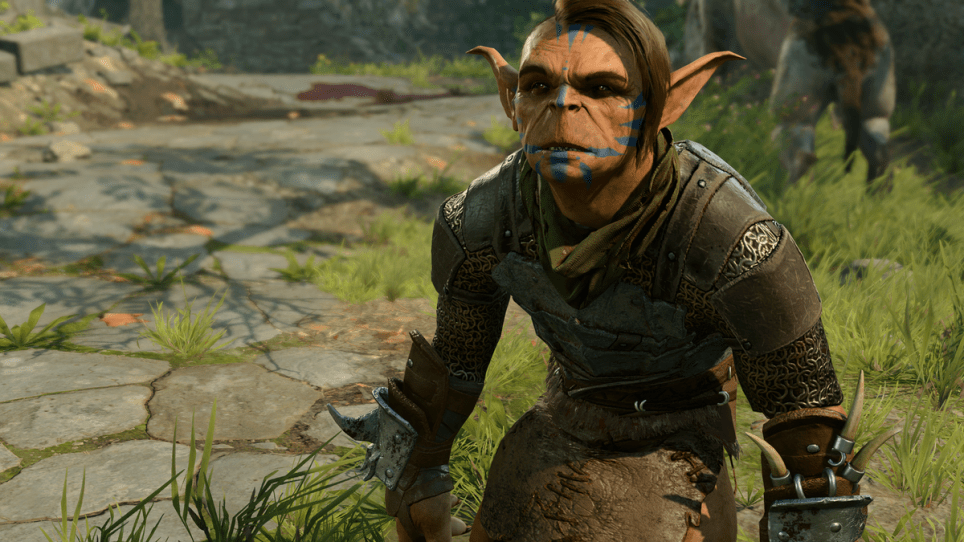
What compounds the problem of discrimination against the goblins is that the central narrative thrust of Act One centers around a racially-driven conflict. On the one side are the Tieflings and druids. The Tieflings, a demonic, red-skinned people with protruding horns and black eyes (see Figure 1), are refugees seeking sanctuary with the druids. They maintain that the goblins (see Figure 2) are out to slaughter them. As such, they need the protection of the druids; the druids, however, have no interest in taking a side in the conflict and are instead attempting to complete a ritual that would warp their grove to another dimension. Without the druids’ help, the Tieflings fear that the goblins will kill them. The leader of the Tieflings therefore asks the player to seek out Halsin, the missing leader of the druids, and beg his aid.

The conflict is very much drawn along racial lines, with the player meant to be the arbitrator of the conflict, its negotiator. But the positioning of events and characters so far means that the player could hardly be expected to be neutral: the Tieflings converse with the player, providing quests and useful services as well as offering generally pleasant or interesting characters to interact with; they are polite, with accents associated with the south of England, what might be called the Queen’s English. Notably, the player may also choose to start the game as a Tiefling character, further encouraging them to side with their compatriots in racial solidarity.
In asking the player to save them from being killed, the Tieflings also make an ethical argument for aligning with them, one of self-defense. The goblins are out for blood and spoils; they are a single people of malicious intent. This is the goblin of the Victorian era that would find its fullest form in Tolkien, a race worthy of nothing but scorn. Thus, “dealing with” the goblins – through slaughtering them – becomes ethically just. Racial cleansing is the only way out. After all, up until this point in the game the goblins have only ever assaulted the player5, a demonstration, if anything, of their evil natures.
Eventually, the player will arrive at the goblin’s camp, which is replete with singing, dancing, and feasting. It is also multiracial, with bugbears and trolls (other large, hairy goblinoids) also in attendance, suggesting that the goblins cooperate with other races. This marks the first and only real opportunity for the player to get a taste of goblin culture. In their appearance, the goblins in Baldur’s Gate 3 certainly fit the mold of that MacDonald would recognize. They are yellow-skinned, with large, bulbous noses6 and over-sized ears, and of short stature, with sharp, pointed teeth. Most curiously, the goblins speak with a distinct accent. In contrast to the Tieflings, they sound like Cockney Londoners, their manner of speech rendered orthographically in the game’s optional subtitles.
The British cockney accent has long had a negative association with the lower classes. Mateo Santipolo (2003) uncovers a 1909 report from the Conference on the Teaching of English in London Elementary School, “issued by the London County Council, where it is stated that: ‘the Cockney mode of speech, with its unpleasant twang, is a modern corruption without legitimate credentials, and is unworthy of being the speech of any person in the capital city of the Empire’” (p. 421). Creative precedence for making goblins talk in “lower-class” British dialect can be found in Peter Jackson’s Lord of the Rings film trilogy as well as the follow-up Hobbit trilogy, where orcs and goblins all use the accent.
Astrid Ensslin (2011) has more directly written about “how linguistic accents of English are functionalized in narrative offline and online computer games to portray a variety of character types and interrelations” and, more specifically, how direct oppositions (e.g., “Standard” Queen’s English versus Cockney) “perpetuate binary thought and stereotyping particularly with respect to morality, erudition, social class, gender, and race” (p. 239). The use of Cockney serves as another example of how Baldur’s Gate 3 draws from the history of Victorian hegemonic racism and classism to distinguish the goblin race as uncouth monsters.
After arriving at the goblin camp, the player discovers the goblins are having their minds controlled by a group of cultists. Interestingly, mind control would surely exculpate the goblins from blame for the attack on the Tieflings. If the goblins were being directly controlled by others, then they could not be responsible for the conflict with the Tieflings; they were simply following the orders of the cult, orders they quite literally could not refuse. This muddies the ethical waters. The goblins are as much victims here as the Tieflings, given that they are being forced into the conflict by the cult, yet there is no path available to the player to save the goblins and Tieflings. One or the other must perish to advance the game.
Importantly, the scenario in which the Tieflings are killed is much more consequential for the player than if the goblins were. Assuming the player sides with and saves the Tieflings, they will appear prominently in the game’s second and third acts, giving quests that lead the player to valuable items and other rewards. Conversely, even if the goblins survive Act One, they simply disappear from the game world altogether. In an interview with IGN, lead writer Adam Smith commented,
I think one of the things that happens on the evil playthrough is I always see this thing where they’re like, ‘Oh, there’s no Tieflings anymore because I killed the Tieflings.’ It’s intentional. Your world is a little emptier because of that, and you are playing a route which is much more selfish and much more, again, afraid. You end up isolated. (Bailey, 2023)
Smith’s statement shows how little is thought of the goblins. Yet why couldn’t they continue to exist in Act Two and Three? The answer seems to be that, unlike the Tieflings, who have their own character backgrounds and personal histories, the goblins exist only as monsters to be slaughtered despite, in many ways, being all too human.
The goblin in Baldur’s Gate 3, then, is ultimately a tragic figure. The player must kill them or else side with them, but even in siding with them, they still disappear. They are never companions. We only learn a couple of their names. We do not know where they come from or where they go if they survive. In the game, they are, like MacDonald’s goblins, a “degraded race” speaking Cockney English, associating them with the “lower classes.” Moreover, their racist and classist treatment is emblematic of the Victorian fantasy novel from which their roots may be traced. Just as The Princess and the Goblin ends with the goblins’ deaths, so it continues to be the case in modern gaming.
Concluding Remarks
In this article I have analyzed the goblin as it appears in Baldur’s Gate 3 in a close reading informed by British literary history, one that goes back to nineteenth-century Victorian England and George MacDonald’s fairytale The Princess and the Goblin in particular. I have demonstrated how Baldur’s Gate 3 perpetuates these Victorian racist and classist tropes in the form of its goblins.
Why take the time to identify and understand these Victorian tropes in Baldur’s Gate 3? At the industry level, the success of the game will doubtless inspire other developers and studios to potentially explore how they might craft their own narrative game. This argument shows that, though there are many things that might be taken and carried forward from Baldur’s Gate 3, this Victorian goblin, this racist and classist monstrosity, should be left in the past. At the individual level, players have many choices to make. While killing the goblins might be construed as the “good” path, I argue that Act One of the game has no good path, seeing as both end in tragedy.
As mentioned at the beginning of this article, goblins can be found in other popular videogames, such as the Final Fantasy series or World of Warcraft (Blizzard Entertainment, 2004). In the case of Baldur’s Gate 3 the goblin is unique insofar as for most games the goblin is an afterthought, one low-level monster among many designed to be defeated and then simply forgotten. (World of Warcraft’s goblins are also a playable race, one that satirizes innovative and quirky inventor-capitalists (and potentially utilizes antisemitic stereotypes). Baldur’s Gate 3, on the other hand, puts its goblins narratively front and center in its first act.
The goblin in Baldur’s Gate 3 is also different from its D&D forebear. During their campaign, players always have the option to do something other than kill. Many groups may still treat the goblins as forgettable monsters that can be murdered to level up, but the alternative, befriending the goblins, is always an option. That is missing from Baldur’s Gate 3. The goblins are either killed or kill, then vanish. There is never a chance to come to a mutual understanding and friendship. The player is forced to make a race- and class-based decision that will permanently shape their storyworld.
Goblins are everywhere in games, yet the ludic goblin has only received limited attention. There is more work to be done on other monsters in games and more to be said about the goblin as well. For instance, Hogwarts Legacy (Avalanche Software, 2023), set in the Harry Potter universe, has a similar conflict with goblins as part of its main narrative thrust. This might be interesting to compare with Baldur’s Gate 3 and a potential starting point for future research. With a greater understanding of the goblin, and other monsters, there might be room for designers to explore more nuanced, and less discriminatory, approaches to implementing these fey creatures in digital games.
End notes
1. Haggard was an English writer who spent seven years in South Africa as a young man and used his experiences as material for his fiction. Burroughs never went to Africa but was famous for his Tarzan series of books, set on the continent. Tolkien was born in South Africa and lived there for a short period in his early childhood.
2. Agata Strzelczyk’s (2022) paper concerning the “evil” race of the Drow, otherwise known as Dark Elves, is a similar project to this one in analyzing the overlap of racism, gender, and monstrosity.
3. See also Tolkien’s The Annotated Hobbit (Anderson, 1988, pp. 108–109) for how The Princess and the Goblin inspired the creation of the goblins in Tolkien’s own legendarium. Additionally, C.S. Lewis’s novel That Hideous Strength references Curdie, one of The Princess and The Goblin’s protagonists, hinting at the text’s influence among the fantasy literati of twentieth-century Britain.
4. A racialized, monstrous goblin may also be observed in other notable writings of the period, such as in Charles Dickins’s The Pickwick Papers (1837) and Christina Rossetti’s poem “The Goblin Market” (1862).
5. It should be noted that there is a goblin prisoner whom players can meet inside the Tiefling camp who can serve as an ally in escorting them to the goblin camp. She is, however, very rude and the player is given multiple opportunities to either execute her or just ignore her. 6. Goblins’ large noses in may be referencing an anti-Semitic racist stereotype also of the Victorian period. This has been a matter of particular discussion in relation to the recent Harry Potter game Hogwarts Legacy (Avalanche Software, 2023). See Horne (2010) and Barratt (2012) for discussions of race in Harry Potter more generally and Stalberg (2022) for a report on Hogwarts Legacy.
Author Biography/Biographies
Benjamin Horn is a Lecturer at the University of Hong Kong. He received his PhD in Creative Media from the City University of Hong Kong in 2021. A recipient of the Hong Kong PhD Fellowship Scheme, his thesis discusses a new model for the analysis of narrative games. His research interests are interdisciplinary, reflecting the multimedia nature of the games he studies, and include questions relating to the interpretation of games, the history of games, the study of ludonarrative artifacts, and issues of cultural localization and translation. He has previously worked as chief writer for a Hong Kong independent game studio.
References
Avalanche Software. (2023). Hogwarts Legacy. Warner Bros. Games.
Bailey, K. (2023, December 15). Baldur’s Gate 3 developers explain its controversial endings, beloved characters, and making the best RPG of 2023. IGN. https://www.ign.com/articles/baldurs-gate-3-final-interview-game-of-the-year-2023-characters-endings
Barratt, B. (2012). Purebloods and mudbloods: Race, species, and power. In B. Barratt (Ed.), The politics of Harry Potter (pp. 59–84). Palgrave Macmillan US.
Beazley, J. & Touma, R. (2024, March 9). Dungeons & Dragons at 50: The collaborative fantasy role-playing game that builds you up. The Guardian. https://www.theguardian.com/lifeandstyle/2024/mar/10/dungeons-and-dragons-at-50-the-collaborative-fantasy-roleplaying-game-that-builds-you-up
BioWare. (1998). Baldur’s Gate. Black Isle Studios and Interplay Entertainment.
BioWare. (2000). Baldur’s Gate II: Shadows of Amn. Black Isle Studios and Interplay Entertainment.
Blizzard Entertainment. (2004). World of Warcraft. Blizzard Entertainment.
Carpenter, B. J. J. (2024). Monstrous adventurers: The racecraft of the dungeons and dragons imaginary. Howard Journal of Communications, 35(1), 15–32.
Carpenter, H. (Ed.) with Tolkien, C. (1981). The Letters of J.R.R. Tolkien. George Allen & Unwin.
Carroll, N. (1990). The Philosophy of horror: Or, paradoxes of the heart. Routledge.
Cohen, J. J. (1996). Monster culture (seven theses). In J. J. Cohen (Ed.), Monster theory: Reading culture (pp. 3–25). University of Minnesota Press.
Clay, J. (1989, January). Hey, wanna be a kobold? Dragon, 141, 38–43.
Crawford, J. (2014). Player’s handbook (5th ed.). Wizards of the Coast.
Crawford, J. (2018). D&D basic rules. Wizards of the Coast.
Crawford, J. (2021). Mordenkainen presents Monsters of the Multiverse. Wizards of the Coast.
Crawford, J. (2024). Player’s handbook (5th ed., 2024 revision). Wizards of the Coast.
Darwin, C. (1871). The descent of man, and selection in relation to sex. John Murray.
Dashiell, S. (2024). Symbolic violence in the language of game descriptions of blackness: The case of pathfinder. Games and Culture, 19(6), 761–782.
Diamond. A. (2022, May 21). Who’s playing Dungeons & Dragons these days? The usual fans, and then some. New York Times. https://www.nytimes.com/2022/05/21/style/dungeons-and-dragons.html
Dickens, C. (1837). Chapter XXVIII: The story of the goblins who stole a sexton. The posthumous papers of the pickwick club. Chapman and Hall.
Ensslin, A. (2011). Recallin’ Fagin: Linguistic accents, intertextuality and othering in narrative offline and online video games. In G. Crawford, V. K. Gosling & B. Light (Eds.), Online gaming in context: The social and cultural significance of online games (pp. 224–235). Routledge.
Ford, D. (2025). Mytholudics: Games and myth. De Gruyter.
Garcia, A. (2017). Privilege, power, and dungeons & dragons: How systems shape racial and gender identities in tabletop role-playing games. Mind, Culture, and Activity, 24(3), 232–246.
Goblin. (2014). D&D beyond. https://www.dndbeyond.com/monsters/16907-goblin
Greenwood, E. & Grubb, J. (1987). Forgotten realms campaign setting. Tactical studies rules.
Gygax, G. & Arneson, D. (1974). Dungeons & Dragons. Tactical studies rules.
Gygax, G. & Arneson, D. (1974). Dungeons & Dragons: Monsters & treasure. Tactical studies rules.
Gygax, G., Cook, D., & Marcela-Froideval, F. (1985). Oriental adventures. Tactical studies rules.
Gygax, G. & Perren, J. (1971). Chainmail: Rules for medieval miniatures (3rd ed.). Tactical studies rules.
Horne, J.C. (2010). Harry and the other: Answering the race question in J.K. Rowling’s Harry Potter. The Lion and the Unicorn, 34(1), 76–104.
King, A. (2023, August 11). Barbie and Baldur’s Gate 3 prove that go woke, go broke doesn’t exist. The Gamer. https://www.thegamer.com/barbie-baldurs-gate-3-go-woke-go-broke-doesnt-exist/
King, M. (2024). Taxonomizing goblins from folklore to fiction. Folklore, 135(1), 87–109.
Larian Studios. (2023). Baldur’s Gate 3, Larian Studios.
MacDonald, G. (1872). The princess and the goblin. Strahan & Co.
McCulloch, F. (2006). “A strange race of beings”: Undermining innocence in the princess and the goblin. Scottish Studies Review, 7(1), 53–68.
Mearls, M., Crawford, J., Sims, C., Thompson, R., Peter, L., Schwalb, R. J., Sernett, M., Townshend, S., Wyatt, J., & Wizards RPG Team. (2014). Monster manual (5th ed.). Wizards of the Coast.
Moore, R. (1982). The humanoids: Goals and gods of the kobolds, goblins, hobgoblins, & gnolls. Dragon, 63 (25–27).
OpenCritic. (n.d.). Baldur’s Gate 3. OpenCritic. https://opencritic.com/game/9136/baldurs-gate-3
Perron, B. (Ed.). (2009). Horror video games: Essays on the fusion of fear and play. McFarland.
Peterson, J. (2012). Playing at the world: A history of simulating wars, people and fantastic adventures, from chess to role-playing games. Unreason Press.
Premont, A. & Heine, S. (2021). The human fantasy: Exploring race and ethnicity through Dungeons & Dragons. FDG ’21: Proceedings of the 16th International Conference on the Foundations of Digital Games, 1–11.
Rossetti, C. (1862). Goblin market and other poems. Macmillan
Santipolo, M. (2003). On the opposite sides of the continuum: Standard British English and Cockney. A historical outline of the parallel developments of the two varieties. Studi Linguistici e Filologici Online.
Schmidt, E. (2019). How well is 5th edition Dungeons & Dragons selling? Unpossible Journeys: Tabletop RPGs in context. https://unpossiblejourneys.com/industry/how-well-is-5th-edition-dungeons-and-dragons-selling/
Stalberg, A. (2022). Hogwarts Legacy made a controversial villain choice. Game Rant. https://gamerant.com/hogwarts-legacy-villain-choice-goblin-controversy-explained/
Stang, S., Meriläinen, M., Blom, J., & Hassan, L. (2025). Monstrosity in games and play: A multidisciplinary examination of the monstrous in contemporary cultures. Amsterdam University Press.
Stang, S. & Trammell, A. (2020). The ludic bestiary: Misogynistic tropes of female monstrosity in Dungeons & Dragons. Games and Culture, 15(6), 730–747.
Švelch, J. (2023). Player vs monster: The making and breaking of video game monstrosity. MIT Press.
Strzelczyk, A. (2022). Discovery of racism in the fantasy genre: The dark elf motif in Dungeons & Dragons. Journal of Gender and Power, 2, 31–46.
Stuart, R. (2022). Tolkien, race, and racism in Middle-Earth. Palgrave Macmillan Cham.
Tally, R.T., Jr. (2022). J. R. R. Tolkien’s “The hobbit”: Realizing history through fantasy: A critical companion. Palgrave Macmillan Cham.
Tolkien, J.R.R. (1937/2001). The Hobbit. HarperCollins.
Tolkien, J.R.R. (1954–1955/2005). The Lord of the Rings. HarperCollins.
Tolkien, J.R.R. & Anderson, D.A. (1988). The annotated hobbit: The hobbit, or there and back again. Houghton Mifflin Harcourt.
Trammell, A. (2016). How Dungeons and Dragons appropriated the orient. Analog Game Studies, 3(1).
Trammell, A. (2018). Representation and discrimination in role-playing games. In S. Deterding & J. Zagal (Eds.), Role-playing game studies: Transmedia foundations (pp. 440–447). Routledge.
Warnes, C. (2005). Baldur’s Gate and history: Race and alignment in digital role playing games. In Proceedings of DiGRA 2005 Conference – Changing Views: Worlds in Play.
Young, H. (2016). Orcs and otherness: Monsters on page and screen. Race and popular fantasy literature (pp. 88–113). Routledge.
 Journal of Games Criticism