by Joel A. White
Published May 2026
Download full pdf of article here.
Abstract
Developed by the Paris-based studio Spiders, GreedFall is a fantasy roleplaying game (RPG) set in in a world that is heavily evocative of European colonialism during the so-called Age of Discovery, with its attendant sailing ships, flintlock weaponry, and exploitation of lands and peoples by colonizing powers. Through narrative content such as cutscenes, character dialogues, and plot points, GreedFall attempts to represent colonialism as unjust and broadly harmful. However, the game simultaneously asks the player to unilaterally map and inflict violence upon Indigenous lands with little to no narrative repercussions. This leads to an acute sense of ludonarrative dissonance (Hocking, 2007), which I unpack here through a combination of theory on postcolonial representation (Spivak, 1993; Hall, 2000) and procedural rhetoric (Bogost, 2008).
I begin by outlining GreedFall’s premise and production context as I consider who speaks to whom through the game’s interactive restaging of colonial encounters. Then, I identify implicit, procedural claims about colonialism that are embedded within GreedFall by categorizing required player actions according to their corresponding colonial roles: cartographer, conqueror, and kingmaker. These roles are not unique to GreedFall, and several of the landmark RPGs that directly inspired GreedFall likewise ask the player to adopt them. Yet by rewarding the player for playing these conventional roles within a narrative context of colonialism, I argue that GreedFall comes to claim that colonialism is inevitable and potentially benevolent. I conclude by outlining two ways RPGs could break with convention to tell anti-colonial stories: by using narrative rewards and punishments to criticize rather than excuse colonial procedures; and by offering the player non-colonial ways of acting within the gameworld. This second strategy in particular hinges on the elevation of Indigenous developers and engagement with Indigenous communities.
Keywords: GreedFall, postcolonialism, procedural rhetoric, RPGs, mapping, representation, When Rivers Were Trails, sovereign games, Indigenous game development
Introduction
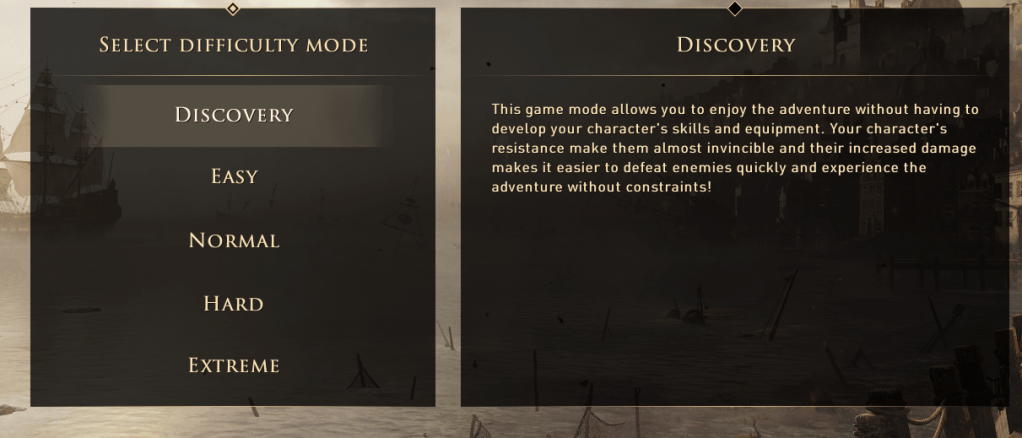
When players begin GreedFall (Spiders, 2019), they are immediately presented with a contradiction. Developed by the Paris-based studio Spiders, GreedFall is a fantasy roleplaying game (RPG) that takes place in a world heavily evocative of European colonialism during the so-called Age of Discovery, with its attendant sailing ships, flintlock weaponry, and exploitation of lands and peoples by colonizing powers. The game’s title, GreedFall, implies a negative judgement of this colonialism. It suggests to players that colonialism is motivated by greed, that it has forced landfall where it does not belong, and that this greedy colonialism may itself fall. Yet when the player is asked to choose an initial difficulty for GreedFall, they may choose to play in “Discovery Mode.” A step below Easy Mode, GreedFall describes Discovery Mode as a way to “defeat enemies quickly and experience the adventure without constraints!” At its outset, GreedFall promises the player two contradictory things: a narrative experience that critiques colonialism, and a ludic or gameplay experience described in terms of adventure and conquest not unlike those applied to colonial projects in centuries past (Mukherjee, 2016).
This early moment where the ludic and narrative elements of GreedFall come into conflict is the beginning of a “ludonarrative dissonance” (Hocking, 2007) that runs throughout the game. In dialogue and cutscenes, GreedFall consistently portrays colonization as a violent and broadly harmful process where colonizing powers unjustly deny the sovereignty of an Indigenous people and expropriate their land. Yet to play the game, the player must consistently perform colonizing behaviors with little to no narrative repercussions. In this paper, I conduct a textual analysis of GreedFall’s ludonarrative dissonance by combining postcolonial theory with Ian Bogost’s (2008) concept of procedural rhetoric. I begin by considering GreedFall’s relatively unique place in the landscape of postcolonial media representation, drawing from the work of Gayatri Spivak (1993) and Stuart Hall (2000) to consider who speaks to whom through this game. Then, I identify implicit, procedural claims about colonialism that are embedded within GreedFall by categorizing required player actions according to the colonial roles of cartographer, conqueror, and kingmaker. These roles are not unique to GreedFall, and several of the landmark RPGs that directly inspired GreedFall likewise ask the player to adopt them. Yet by rewarding the player for playing these conventional roles within a narrative context of colonialism, I argue that GreedFall claims that colonialism is inevitable and potentially benevolent. The resulting ludonarrative dissonance may serve productive ends, however, as it highlights how RPGs must critique certain genre conventions or break with them entirely if they are to tell truly anti-colonial stories. I thus move to outline two ways RPGs could tell such stories: through deconstructive uses of narrative judgement or through procedures that entail non-colonial ways of relating to the gameworld. This second strategy carries the greatest critical potential, and it is most achievable through a sovereign games approach (LaPensée et al. 2022) that elevates Indigenous developers and engages with Indigenous communities.
Locating Greedfall
GreedFall takes place almost entirely on a fictional island called Teer Fradee. Teer Fradee is inhabited by a people whom most characters call “the Natives” but whom I will call Teer Fradeans. Though they live in largely autonomous, clan-based communities, Teer Fradeans speak a common language and have a shared culture that is grounded in reciprocal relationships with the island and its non-human inhabitants. The player arrives on Teer Fradee as De Sardet, an aristocratic diplomat from the Congregation of Merchants.1 A mercantile nation on the continent of Gacane, the Congregation is the weakest and most recently arrived of three colonizing powers on Teer Fradee; the other colonizers are the theocratic Thélème and the technocratic Bridge Alliance. Alongside a party of companions, the player must navigate successive political intrigues between factions in search of a cure to “the Malichor,” a mysterious disease that has devastated Gacane while leaving Teer Fradee untouched. The narrative focus on colonization in GreedFall is unusual for the fantasy RPG genre, which may be why some games media outlets have praised GreedFall for the uniqueness of its setting (Palumbo, 2019; Thurlow, 2024). However, in terms of its gameplay design, GreedFall is thoroughly conventional, with the developers at Spiders stating that they drew inspiration from such established fantasy RPG franchises as The Elder Scrolls (Bethesda Softworks, 1994- ), The Witcher (CD Projekt RED, 2007- ), and Dragon Age (BioWare, 2009- ) (Spiders_Team, 2019). The similarities between GreedFall and Dragon Age are so strong that GreedFall has been featured in lists published by games media outlets that highlight games “like Dragon Age” (Wojnar, 2022; Stalberg, 2024). One of these lists is how I, a settler and RPG enthusiast on Treaty 6 Indigenous land colonized by the Canadian state, found GreedFall.2 What attracted my attention to GreedFall compared to the franchises that inspired it is that, while those other properties all integrate themes of colonization into their respective settings, only GreedFall makes colonization the core concern of its narrative.
GreedFall represents real processes of colonization in its fictional fantasy world. The use of religion as an instrument of colonization by Thélème, the biological experimentation upon Teer Fradeans by the Bridge Alliance, and the theft of Teer Fradean land by all three colonizing powers have historical antecedents in European colonial projects (McCallum, 2017; Renzo, 2019; Rumford-Rodgers et al., 2023). Whenever De Sardet and their companions encounter such abuses, they verbalize their horror and disgust. Further, while the player is usually given a choice in how to respond to specific injustices, they are rarely allowed to side against Teer Fradeans and never when they suffer flagrant dehumanization through abduction, torture, or murder. By establishing a division wherein allied characters criticize and fight against colonialism while enemy characters actively steal from and assault Teer Fradeans, GreedFall attempts to adopt an anti-colonial position. I use the term anti-colonial here to describe a position “oriented toward resisting, fighting against, and dismantling the aims of colonial regimes, systems, and ideologies” (Nunn and Whetung, 2020, p. 155). This is not to say that Spiders intended GreedFall to be a strong political statement in any particular direction. Rather, the studio narratively marks certain characters as greedy, cruel colonizers so the player can have the guilt-free pleasure of dominating and killing them. That Spiders anticipated players would want to fight on behalf of Teer Fradeans is apparent not only in their narrative representation of colonization but also in how they address players as “Carants” in community update articles (Spiders, 2024). Carants is a Teer Fradean word that means friend; Teer Fradean clans describe De Sardet as their Carants if the player advocates or fights for them against colonial incursions. Thus, through its negative representations of colonialism, Spiders assumes players of GreedFall will come to identify as an anti-colonial Carants to the Teer Fradeans.
Representations like those in GreedFall are not always received in the way they are intended; as Spivak (1993) makes clear, this is especially true when colonial politics affect dynamics of expression and reception. Spivak defines representation in two distinct yet related ways: “representation as ‘speaking for,’ as in politics, and representation as ‘re-presentation,’ as in art or philosophy” (p. 70). The representation of colonialism in GreedFall fits somewhat into both categories. It represents colonialism in the artistic form of a video game, and this representation takes on a political dimension in relation to debates about the redress of historical and ongoing colonialism. However, Spivak demonstrates how representation risks becoming appropriation when the represented subjects have limited power to speak for themselves. As an example, she analyzes the colonial discourse around the practice of sati, or widow sacrifice in India prior to British colonization. Spivak shows how the experiences of Indian women are discursively represented first as victims by British imperialists seeking to justify colonization and then as willing sacrifices by Indian nativists who resist colonization within a masculinist paradigm. In this discursive conflict, Indian women are constructed in such a way that coheres “with the work of imperialist subject-production” even by certain nativist critics of colonialism (Spivak, 1993, p. 92). Spiders likewise attempts to represent its player as an anti-colonial Carants in a way that fits neatly within an imperialist worldview. Specifically, the studio uses the vocal protestations of sympathetic characters in their game to suggest that what colonizers are doing to Teer Fradeans is wrong, yet its procedural logic denies Teer Fradeans the ability to decolonize their own lands. Indeed, GreedFall does not allow decolonization by anyone, as the only procedures the player may follow to address colonial harms also involve dominating Teer Fradeans and their lands. In the procedural-discursive construction that Spiders has created, there is a recognition of colonial injustice, but no way out of colonial relationships.
Before I examine GreedFall’s procedural rhetoric in detail, I must first note the positional irony that separates the discursive example of GreedFall from Spivak’s (1993) analysis of the discourse around sati. While there are excellent examples of video games developed by and in collaboration with Indigenous peoples that represent colonialism and Indigenous survivance, such as Never Alone / Kisima Inŋitchuŋa (Upper One Games, 2014), When Rivers Were Trails (LaPensée & Emmons, 2019), and Hill Agency: PURITYdecay (Achimostawinan Games, 2023), Indigenous-controlled representations of colonialism are not readily visible within the fantasy RPG genre. Instead, GreedFall is perhaps the most publicized recent representation of anti-colonialism in the genre—even though it was created by a studio situated in metropolitan France. Through GreedFall, Spiders becomes both the imperial speaker and their supposed critic. The way Spiders attempts to speak with this double voice marks GreedFall as a potentially misleading and even harmful piece of postcolonial representation. As Stuart Hall (2000) notes, the term postcolonial in its most productive sense refers to the awareness of a “double inscription” of colonialism upon the cultures of colonizers and colonized (p. 242), with the boundaries between those subjectivities becoming somewhat less obvious following the independence movements of the 20th century. Hall asserts that the postcolonial is about “different ways of ‘staging the encounters’ between colonising societies and their ‘others’” to make sense of a moment wherein direct colonial rule has widely subsided yet global structures of exploitation and inequality remain (p. 243). If media representation is a type of encounter staging, then GreedFall has the potential to affect how audiences make sense of colonization, what it was, and how it structures the present. There is a market for such representations (Mukherjee & Hammar, 2018; Bird, 2023), and Spiders thus sells a narrative that some accept as timely and anti-colonial (Thurlow, 2024; Hafer, 2019) but which is actually co-constitutive with imperial positions. By imperial positions, I mean both the studio’s position as a game developer in an imperial metropole and the colonial roles it assigns the player: cartographer, conqueror, and kingmaker.
Colonial Roleplaying
Procedural Rhetoric
As a video game, GreedFall makes arguments through its procedural structures on top of—or rather underneath—the arguments it makes through oral and visual representations within its gameworld. Ian Bogost (2008) first articulated procedural rhetoric as “the practice of using processes persuasively, just as verbal rhetoric is the practice of using oratory persuasively and visual rhetoric is the practice of using images persuasively” (p. 125). Bogost states that procedural rhetoric begins with a “possibility space,” or “a free space of movement within a more rigid structure” (p. 120). Each video game is a possibility space where players may move in ways that are impossible in their daily lives; players might indulge in violent combat, cast spells, travel through time, and more. However, no possibility space is completely flexible or without structure; as Bogost makes clear, it is the rules or “procedures” governing a possibility space that allow it to exist in the first place. For example, in a game of monster hunting, rules must first mark who is the monster and who is the hunter before monster hunting can take place. These kinds of procedures become persuasive when they shape a possibility space in ways that make implicit claims. Does the monster hunter have to work with others to get results, or can they take down their quarry purely through individual strength? How do environments affect conflict—do “natural” environments favour monsters? And is conflict with the monsters inevitable? Depending on how its procedures answer these questions, the game could make different claims about agency, humanity’s relationship to the environment, and the types of actions that promote safety. In certain representational contexts, games may also make procedural claims about colonialism, leading Mukherjee (2023) to coin the term “procedural colonialism” to describe instances where those claims are in support of imperial powers.
The following three sections examine the procedural colonialism embedded in the ways GreedFall encourages its player to navigate the possibility space of Teer Fradee. Because GreedFall is an RPG, I look at its procedural claims in terms of the roles they define for the player. First, I demonstrate how GreedFall’s mapping system operates according to colonial procedures that elevate the player’s cartographic knowledge above Teer Fradeans’ knowledge of their own land. I then discuss how rules around violence and character progression gradually shape the player, through De Sardet, into a conqueror of Teer Fradee. Once the player masters their roles of cartographer and conqueror, GreedFall allows them to become a kingmaker as they decide who rules Teer Fradee, which I critique as the culmination of the game’s colonial and paternalistic procedural arguments.
The Player as Cartographer
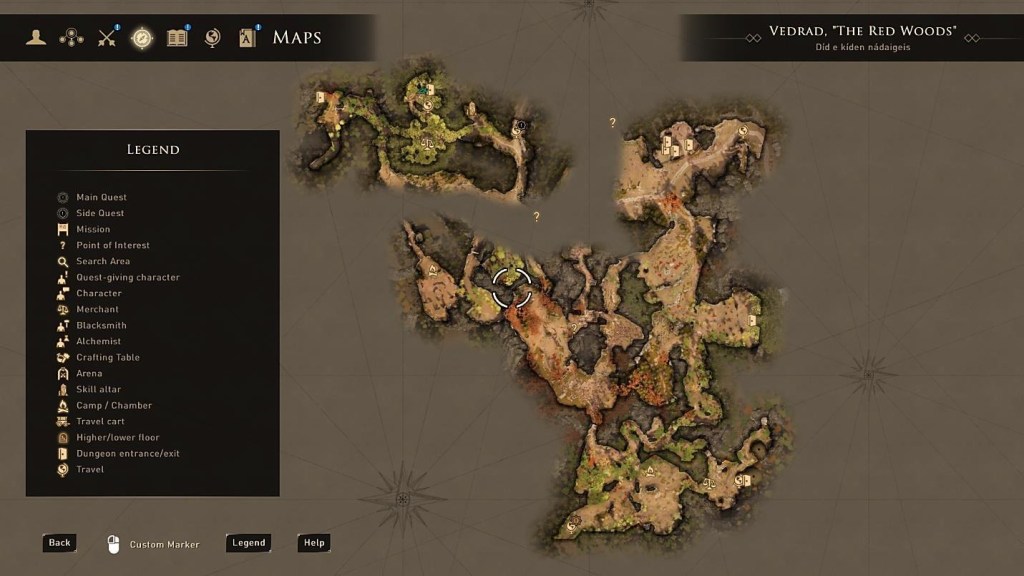
The player navigates Teer Fradee primarily through a string of interconnected area maps. When the player first enters an area, its map is entirely grey, simulating a fog-of-war that disperses to reveal detailed topography as the player covers ground. Above the fog, all maps are pre-marked with points of interest for the player to find, such as campsites and quest events. This style of objective-driven cartography mimics how exploration works in two of the inspirations behind GreedFall, Dragon Age: Inquisition (BioWare, 2014) and The Witcher 3: Wild Hunt (CD Projekt Red, 2015), which were themselves modelled in response to the seismic success of Skyrim (Bethesda Softworks, 2011) and its explorable open-world (Schreier, 2017, p. 149, p. 233). In making the player an explorer of unfamiliar lands, conventional RPGs require one to play through a non-Indigenous subjectivity in relation to the gameworlds, a subjectivity that can become colonial as they remap territory with themselves and their needs at the centre. Souvik Mukherjee (2016) explains this digital remapping process and its imperial resonance with reference to The Great Trigonometric Survey of India led by George Everest. Everest not only charted the Indian subcontinent in the service of British domination; he also mapped his own name onto its highest peak, symbolically constructing the British subject as the master of India (Mukherjee, 2016). As De Sardet, the player maps Teer Fradee according to their quest objectives; players unlock new areas by progressing in the questline, and they unilaterally mark Teer Fradee’s surface by setting up campsites that allow them to fast-travel to their next objective. Through this process, GreedFall’s map becomes less a representation of Teer Fradee’s environments than a tool for transforming them with “specific game-rules [and goals] in mind” (Lammes & Wilmot, 2013, as cited in Mukherjee, 2016, p. 508). While the coloniality of this conventional approach to mapping been noted in prior scholarship on RPGs (Meaning, 2020), GreedFall’s marginalization of Indigenous geographic knowledge is rendered uniquely visible in an awkward, dissonant scene that takes place immediately after De Sardet arrives on Teer Fradee.
As De Sardet goes to meet the Congregation governor for the first time, they are intercepted by Síora, a Teer Fradean spiritual leader seeking Congregation aid in her clan’s war against the Bridge Alliance. She joins the player’s party and is therefore automatically present when a member of the governor’s retinue asks De Sardet to set up exploration camps in each region of Teer Fradee. Even though members of De Sardet’s party interject in conversations throughout GreedFall, Síora says nothing when the player receives this quest, despite the resentment of colonial incursions that brought her to De Sardet in the first place. She can neither object to the proposed exploration nor offer her knowledge of the land to curry favour with a potential military ally. To invoke Spivak (1993), the subaltern here cannot speak, especially when doing so carries the potential to disrupt RPG conventions of player-driven exploration. Further, Síora’s role in this encounter and in exploration more generally parallel those assigned to Sacajawea and other Indigenous people in narratives around the various Euro-American explorers of the 19th century. As Pillow (2012) notes in an article on media representations of Sacajawea, her “identity and subjectivity were constructed as representative of Indian cooperation and culpability” in the colonization of their lands (p. 48). In the novels and documentaries referenced by Pillow, Sacajawea’s presence is framed as legitimating the activities of the activities of enlightened, male colonizers who supposedly did not need her assistance. Similarly, Síora’s silent presence in this early scene lends tacit permission for the mapping of Teer Fradee through procedures that render her knowledge of the land immaterial to the player’s success. In this way, and like older mediations of colonization, GreedFall suggests that useful knowledge of land is produced by a cartographic, Western subject who remaps territory according to their individual needs.
The Player as Conqueror
Most RPGs, including GreedFall, have at their core the same process that enables colonialism: organized violence. Yet this does not make RPGs inherently colonial. As Franz Fanon (1961/2021) makes clear, violence may be as much a tool in decolonization as it is in colonization. When Fanon writes that decolonization is “always a violent event … the substitution of one ‘species’ of man by another” (p. 30), he refers to more than the forcible overthrow of repressive colonial institutions. In Fanon’s work, violence is an essential part of both colonial and decolonial subject formation. After all, the subjectivities of “colonizer” and “colonized” do not predate the violence of colonization; they are formed by it. In a colonial situation, colonizers are those who establish their privileged position through legal violence from which they are protected and to which the colonized are subjected, relegating the latter to a lower level of humanity. Under this framework, taking power over violence and using it to overthrow this hierarchical order is how Fanon argues the formerly colonized subject regains their agency and full humanity. Of course, different instances of decolonization may call for nonviolent resistance in addition to or instead of violent action. That being said, GreedFall, like the RPGs it mimics, operates according to a logic where violence is the primary force of change. We may therefore look to the procedures governing violence in GreedFall—who may inflict it upon whom, whose violence is most powerful—to see how it constitutes subjects and to what end.
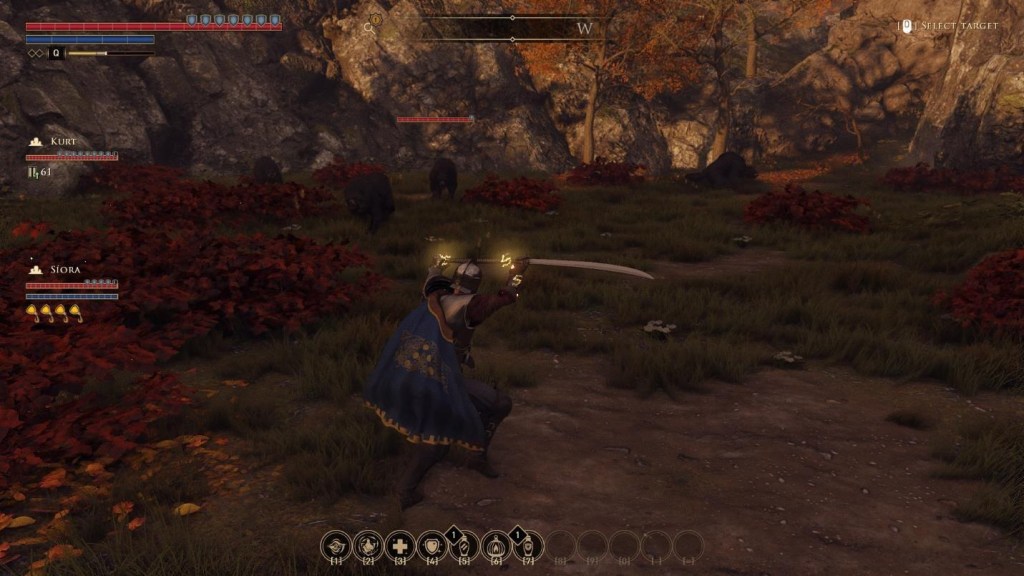
GreedFall does not shy away from depicting colonization as violent and has intricate subplots dealing with the theological and technoscientific frameworks that Thélème and the Bridge Alliance respectively use to justify violence against Teer Fradeans. However, Teer Fradeans are incapable of reacting with sufficient force. Only the player through De Sardet wields the power to change or overthrow these oppressive frameworks. In their interactions with other powers, De Sardet may and often must engage in violent combat. As is the case in most RPGs, winning in combat allows the player to loot equipment from their dead foes and gain experience points, leading to incremental “level-ups” that increase De Sardet’s power and eventually allow them to inflict greater violence than any other being on the island. Through this violent process, De Sardet goes from the relatively weak diplomat they arrived as on Teer Fradee to someone who seizes control over its destiny through violence: a conqueror.
Teer Fradeans variously figure into this arrangement as supporting allies or minor obstacles, as exemplified by the quest “Scholars in the Expedition.” In this quest, De Sardet must track down a missing group of researchers on behalf of the Bridge Alliance; when they find the body of a researcher who was apparently killed by Teer Fradean warriors, De Sardet’s companions are quick to voice their opinions. Most remark that they believe the killing to be justified given the colonial abuses inflicted on Teer Fradeans in Bridge Alliance experiments. In fact, the only unfavourable judgement of the killing comes from the mercenary Kurt, who objects not to the killing itself, but the fact that it did not happen in “honourable” combat. Despite the broad consensus that the warriors are justified in their resistance, the player as De Sardet must rescue the surviving scholars from a Teer Fradean camp to access their research on the Malichor plague. To do this, the player can either defeat the warriors in combat or convince them that continuing to imprison the scholars will invite retribution they cannot hope to withstand. In the instance of persuasion, the player essentially asks the Teer Fradeans to put their resistance on hold until De Sardet is ready to support them, and indeed, there is an optional questline later in the game where De Sardet can execute the Bridge Alliance’s unethical chief researcher. The procedural representation of Teer Fradeans in these and other questlines evokes white saviour films that represent Indigenous characters as “beautiful, spiritual, and reverent to God and earth,” ethereal to the point where they are represented as materially ineffective until their mobilization by an outsider (Cammarota, 2011, pp. 247-248). In making Teer Fradean ‘freedom’ dependent on De Sardet, GreedFall suggests that Indigenous peoples cannot be in control of their own material destinies and must rely on a colonizer-turned-saviour, which Fanon (1961/2021) would rightly argue is no true decolonization at all.
The Player as Kingmaker
Though the player procedurally conquers Teer Fradee through GreedFall’s combat, they cannot play as its sovereign.3 In fact, most RPGs do not allow the player to make their character a ruler, likely because the work of ruling would interfere with the thrills of direct exploration and conquest. As a compromise, RPGs often allow the player to exercise political power by having them choose which characters will rule the gameworld. Skyrim (Bethesda Softworks, 2011), Dragon Age: Origins (BioWare, 2009), Dragon Age: Inquisition (BioWare, 2014), and The Witcher 3: Wild Hunt (CD Projekt RED, 2015) all feature at least one such kingmaker subplot. GreedFall follows in their footsteps when it asks the player to support one of three Teer Fradean chiefs vying to be elected High King by a council of their fellow chiefs. Admittedly, in analyzing this particular choice, I am skirting the lines between procedural and narrative analysis; however, branching narratives operate according to procedures similar to those that govern gameplay, wherein certain player inputs are scripted to lead to corresponding outcomes. Further, the quest involves the manipulation of the rules and procedures governing Teer Fradean society in a way that evokes the installment and manipulation of Indigenous monarchs by European colonial powers (Groenhout, 2006; Aldrich, 2018).
The player is able to control the outcome of the election by giving their favoured candidate a mythic crown said to have been worn by the first High King, which the player obtains by finding and violently raiding said King’s burial crypt. The premise of this quest is that the cultural and symbolic power of the crown is in itself sufficient to sway all necessary votes to De Sardet’s chosen candidate. This specific setup of this kingmaker scenario is nearly identical to those in Skyrim and Dragon Age: Origins, which likewise ask the player to fight through a crypt to obtain the symbolic value of a crown. What is a relatively benign adventure in these other games becomes offensively colonial in the narrative context of GreedFall. Aside from the obvious parallels between De Sardet’s raid of the tomb and the actual looting of cultural treasures by European colonizers, the fact that De Sardet can manipulate the council into voting their way through the crown makes an implicit claim about Teer Fradean irrationality. De Sardet seeks to raise a new High King so that this king will help them ask an island spirit named En on Míl Frichtimen about a cure for the Malichor plague; this is a rational objective that De Sardet pursues by allying with someone who will help them achieve it. By contrast, the nameless, homogenous Teer Fradean council automatically and apparently unthinkingly follow a cultural totem, which has become a sub-convention within the kingmaker scenario. Here GreedFall procedurally represents Teer Fradeans as incapable of making rational political decisions in a manner that fits into an extensive tradition of European and settler-state narratives that depict subjugated cultures as inferior and in need of guidance from Western civilizations (Said, 1979; Cammarota, 2011).
Dissonant Arguments
Taken together, GreedFall’s procedural claims of Teer Fradean irrelevance, ineffectiveness, and irrationality form an argument that colonialism naturally occurs when a superior, agential culture of subjects encounters an inferior culture of objects. Based on their communications around the game, I assume that Spiders did not intend to forward this argument, but as Bogost (2008) notes, a game’s procedural rhetoric does not necessarily correspond with the designer’s intent. At the same time, GreedFall narratively argues that colonization is morally wrong, broadly harmful, and should be undone. It is almost able to effectively advance this argument in a few moments. For example, in the cutscene where De Sardet meets En on Míl Frichtimen, the spirit informs them that the Malichor is not a plague, but rather environmental poisoning brought on by the extractive land management of the colonial powers on their home continent. This is GreedFall at its most meaningfully anti-colonial, as it reveals the solution to the player’s problem is not in the colonial extraction of a cure from Teer Fradee but in the dismantling of colonial extraction and the structures that support it; the narration provided by En on Míl Frichtimen informs the player that the world is worse off if Teer Fradee is colonized and pillaged. Yet the critical potential of this revelation is undercut by the procedures the player must enact to reach it, as the game rewards them for personally colonizing and pillaging Teer Fradee. Dissonance abounds as GreedFall argues with itself.
The only way to reconcile GreedFall’s contradictory arguments is to combine them into a new one: colonialism is bad, unless it is done kindly and for the right reasons. This argument is absurd on its face, and Spivak (1993) shows us its dangers when, in regard to sati, she interrogates the colonial fantasies conjured by the sentence “white men are saving brown women from brown men” (pp. 92-93). Just as that sentence allows white colonizers to construct themselves as benevolent saviours, I argue that GreedFall allows players to adopt the oxymoronic subjectivity of a benevolent colonizer who “saves” Indigenous people from worse colonizers. In both cases, salvation becomes subordination. The white saviour-esque fantasies conjured by GreedFall have been represented countless times before, though the game shows how they can be articulated in a relatively new media form using the dual messaging of its ludic procedures and narrative events. If GreedFall can be said to achieve something in terms of anti-colonialism, it is that the game’s ludonarrative dissonance points to ways RPGs must change if they are to tell truly anti-colonial stories.
Mapping New Paths
Given that GreedFall’s colonial claims are rooted in genre conventions, it may be tempting to claim that RPGs are inherently colonial, or that they are at the very least ill-suited for anti-colonial storytelling. While it is true that many games “train players to learn an empathy for the ideology of colonialism” (Trammell, 2022, p. 241), designer Meghna Jayanth (2021) optimistically and rightly points out that this training function could run in reverse and that games may also promote empathy for genuinely anti-colonial positions. I draw from the work of Jayanth and others in this coda as I outline two ways that RPGs might avoid the colonial pitfalls that ensnared GreedFall: using rewards and punishments to critique colonialism and offering noncolonial roles for players to perform in the gameworld, as exemplified by the mapping system in When Rivers Were Trails (LaPensée & Emmons, 2019).
Punishing Journeys
Building on Bogost’s (2008) concept of procedural rhetoric, Eugen Pfister (2021) emphasizes the potential for games to convey ideological models of the world through how they reward or punish procedural actions. Pfister notes that games may offer these judgements diegetically through in-game feedback or extra-diegetically through achievements, which collectively form a kind of metanarrative on the player’s actions in the gameworld. Though GreedFall provides diegetic rewards for compliance with the ideology of colonialism—giving the player items and experience points for violently exploring Teer Fradee—I want to highlight a specific moment during the kingmaker scenario where the game could have rewarded decolonial action through its achievement system.

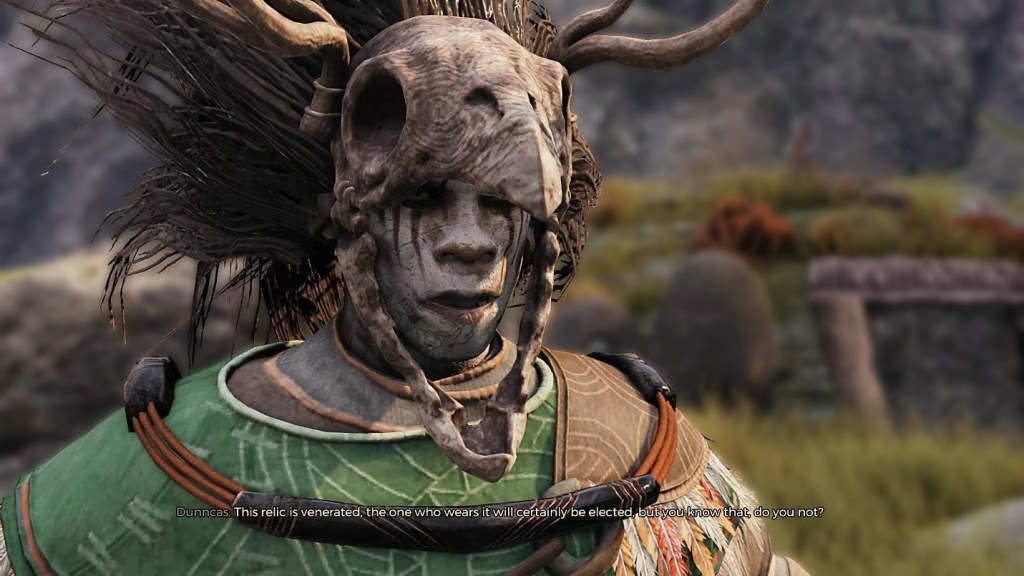
Derdre, one of the candidates for Teer Fradee’s throne, confronts De Sardet in the burial tomb where they find the crown and criticizes them for their interference in Teer Fradean affairs; Derdre then threatens De Sardet for the crown at sword point. If the player chooses to respect her threat and avoid combat by handing over the crown, the post-credits slideshow states that she eventually drives all the colonists off Teer Fradee. The achievement for this ending is called “Back to the Roots,” which frames Teer Fradean sovereignty as a kind of regression. By contrast, defeating Derdre in combat and granting the crown to Dunncas, a candidate who promotes peace on vague spiritualist notions of “balance” yields an ending where the colonial powers learn healthier land management practices from the Teer Fradeans. In this ending, which is accompanied by an achievement with the unambiguous title “A Better World,” the Malichor plague subsides, yet Teer Fradee is not decolonized. This framing of the different endings is consistent with GreedFall’s procedural claims about the inevitability and possible benevolence of colonialism. But what if GreedFall had reversed these judgements and rewarded the player for surrendering to Derdre by claiming that “A Better World” is one in which Indigenous peoples seize their full humanity, regardless of how that affects colonizers?
A different sort of ludonarrative dissonance would have arisen in the hypothetical scenario I describe above, as the player is not able to surrender or be rewarded for surrendering in routine combat encounters. In other words, the game would be patting the player on the back for taking an action it prohibited them from doing earlier. However, this dissonance could give rise to critical questions that deconstruct colonial ideologies: would it have been better if I, as the colonizer De Sardet, had never come to Teer Fradee in the first place? And more importantly, by what right does the well-being of colonial societies take precedence over Indigenous sovereignty? Such deconstructive uses of ludonarrative dissonance have achieved success in other genres. For instance, Walt Williams (2013) notes how his writing team at Yager Development narratively questioned procedural actions in Spec Ops: The Line (2012) to get the player to critically reflect on assumptions common to the first-person shooter genre. Though Spec Ops: The Line is partly built on colonial stereotypes around race and gender (Murray, 2016), Williams’s insight that ludonarrative dissonance means “your character is a hypocrite … and we [developers] need to write them as such” (2013, 6:00-6:25) carries great potential for subversive design across genres. For instance, an RPG that largely operates according to convention could use diegetic and extra-diegetic narration to present the protagonist as hypocritical in ways that encourage players to interrogate colonial ideologies.
Throwing Away the Colonizer’s Map
A more radical and likely more effective way to tell anti-colonial stories through RPGs would be to move away from what Jayanth (2021) calls “white protagonism,” or game design that caters to the “imperial pleasures” of power and domination through the protagonist (15:13-17:35). In terms of RPGs, indulging imperial pleasures means performing colonizing roles that, as GreedFall demonstrates, can undermine an anti-colonial narrative. Making RPGs that do not depend on the violent domination of the gameworld to offer the player pleasure would in turn provide opportunities for players to perform non-colonial roles. For a brief example of what such non-colonial roles might look like, I look to the exploration system in When Rivers Were Trails (LaPensée & Emmons, 2019) and its refusal to make the player a colonial cartographer.
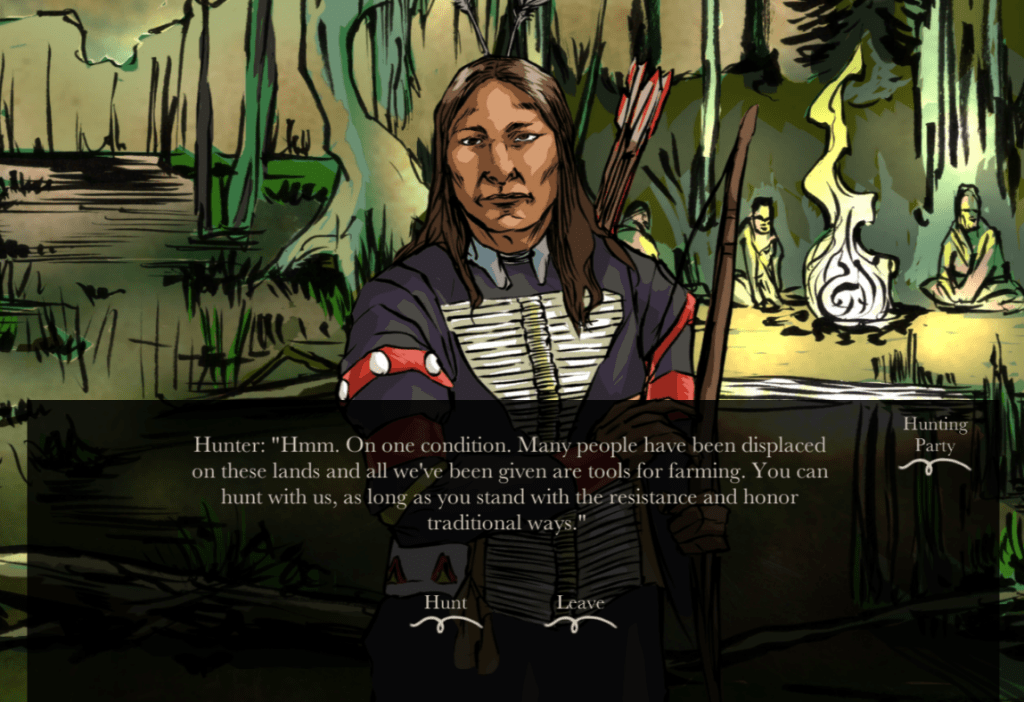
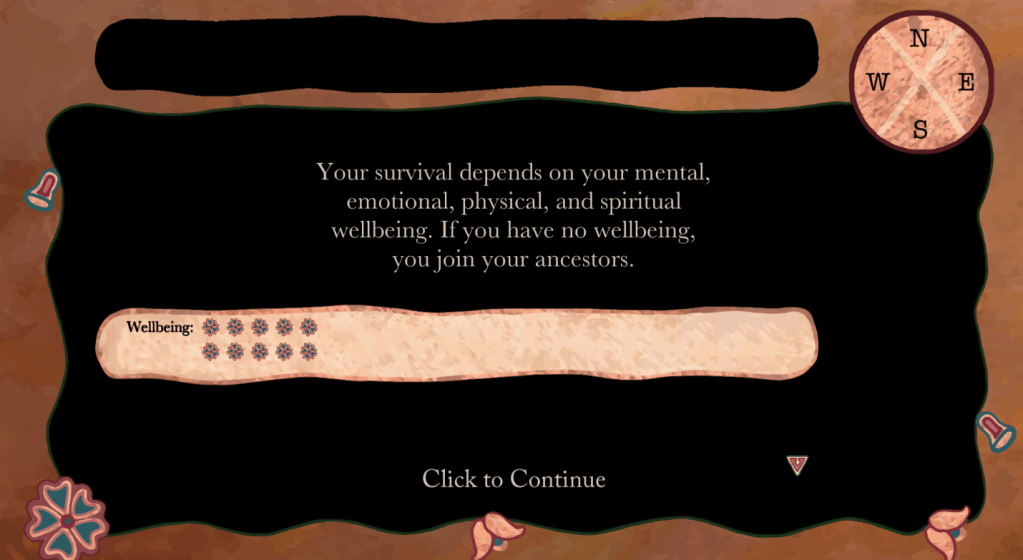
When Rivers Were Trails is a point-and-click adventure that LaPensée et al. (2022) describe as a “sovereign game,” or a game “where Indigenous people are in leading roles” (p. 329). Such games, they say, have the potential to be sovereign “in terms of development [Indigenous owned and/or led] as well as content [supportive of Indigenous sovereignty]” (p. 329). When Rivers Were Trails is sovereign in both ways; created with the participation of over 30 Indigenous contributors and in consultation with Indigenous communities, When Rivers Were Trails demonstrates how a player might travel the gameworld in a non-colonial manner. Playing as an Anishinaabeg person displaced under The Allotment Act of 1887, the player explores unfamiliar lands as they move from their people’s traditional territory near the Great Lakes to the West Coast. Crucially, the player’s understanding of each locale they find themself in is dependent on their interactions with the Indigenous inhabitants of that area. For example, finding that there is a good fishing or hunting spot in one area may require you to give tobacco or food to an Elder who lives there. This is similar to the way some open world RPGs integrate NPC location tips, with two key differences: reciprocity and relationality are necessary for all kinds of navigation, not just treasure hunting; and the player is not conquering territory or elevating themself above it. What’s more, the player character’s own essential connection to the land and its inhabitants is integrated into gameplay through a well-being meter that requires them to maintain their relationships just as they must maintain their supplies of food and medicine.
The successful player of When Rivers Were Trails thus takes on the role of Indigenous traveller, not of colonial cartographer. This is not an inevitable result of the fact that the game casts the player as an Indigenous character in its narrative; as Bird (2023) argues, while such narrative representation is important, games like Assassin’s Creed III (Ubisoft Montreal, 2012) and This Land is My Land (Game-Labs, 2021) show that games which cast the player as an Indigenous character may still operate according to procedures based in colonial domination.4 Thus, a full break with white protagonism not only requires Indigenous narrative representation, but also the kinds of reciprocity-based procedures that When Rivers Were Trails exemplifies. RPGs that aim to tell anti-colonial stories would do well to have players adopt roles that are similarly grounded in reciprocity and interdependence. The stories told by these RPGs that place players in such roles would not need to be dissonant, deconstructively or otherwise—they could simply be decolonial.
I speak of decolonial rather than anti-colonial RPGs because, for pleasures to go beyond colonialism, they must do more than just resist it—though as the Cree poet Billy Ray Belcourt (2016) notes, imagining non-colonial worlds is in itself a type of resistance. Paraphrasing Jack Halberstam (2013), Belcourt says that “revolt is not merely to attack the fucked-up … but to dream up worlds in which those problems cannot exist as such.” Similarly, Jayanth (2021) suggests the duty of game designers vis-à-vis colonialism is to offer players the opportunity to dream of better, alternative worlds (10:22-10:48). In this mission, Jayanth stresses the importance of game designers from traditions outside “the Anglo-American imagination” (50:29-50:43). I would argue that given the colonial procedures in GreedFall, Jayanth’s arguments could be affirmed and extended to include the Euro-colonial imagination of studios like Spiders.5 Simply put, the best anti-colonial and decolonial RPGs will likely come from designers who are not situated comfortably within the heart of imperial powers. These games could restage colonial encounters in ways that could judge colonialism justly, grant greater agency to Indigenous characters, and help audiences navigate the world with empathy for anti-colonial positions, free from the kind of ludonarrative dissonance at play in GreedFall.
Of course, games are functions of economy and materiality as much as they are a function of their designers’ identities, if not more so. This is something Hammar (2020) makes clear in his analysis of Mafia III (Hangar 13, 2016), wherein he claims that the game is unable to emphasize connections between capitalism and structural racism because of its production context; as a game published by a major corporation and sold on the mass market, Mafia III’s ability to critique the conditions of its own existence was limited. Similarly, Baeza-González (2021) argues that game developers who occupy a peripheral position in relation to the markets of North America, Europe, and Japan must adapt or avoid game content particular to their own cultures to compete on those dominant markets. Therefore, those of us who are interested in decolonizing RPGs and video games must support the material actions that allow for game development in the periphery on the terms of those that live in it, rather than on the terms of the dominant markets. Depending on one’s location, such material actions may include providing development knowledge and resources to Indigenous communities (LaPensée & Lewis, 2011), dedicating public arts funding to Indigenous games development (Screen Australia, 2023; Indigenous Screen Office, 2025), and supporting crowdfunding campaigns for Indigenous development projects. Without material actions like these that allow Indigenous developers to control the production of their own games, decolonizing gaming becomes little more than a metaphor—or worse, a “move to innocence” (Tuck & Yang, 2012, pp. 9-28) that allows settlers like myself to digitally adopt Indigenous subjectivities in play without providing material support for Indigenous self-determination in return. While video games can of course serve anti-colonial ends by criticizing and providing alternatives to colonial models of the world, they would only be decolonial where the contexts of their production and reception help bring about “the repatriation of Indigenous land and life” (Tuck & Yang, 2012, p. 1).
Conclusion
Through the dissonance between its anti-colonial narrative posture and its deeply colonial gameplay procedures, GreedFall exemplifies how RPGs must break with certain genre conventions to tell truly anti-colonial stories. I began my analysis by considering GreedFall’s function as a restaging of colonial encounters designed by a studio that, despite its comfortable location within an imperial metropole, nonetheless attempts to represent and “speak for” the subaltern (Spivak, 1993). I then examined the claims about colonialism that are embedded in GreedFall’s gameplay through the lens of procedural rhetoric (Bogost, 2008), showing how the game affirms the player’s right to unilaterally map Indigenous land, inflict violence on its inhabitants, and decide its future. In sum, the game suggests that acts of colonization may be justified so long as they are cloaked in a narrative of benevolence.
Finding the paternalistic, white saviour ludonarrative of GreedFall unsatisfying, I outlined two strategies through which RPGs might advance anti-colonial ends. The first strategy is to use narrative to question rather than affirm the player’s colonizing actions, similar to how Spec Ops: The Line (Yager Entertainment, 2012) offers critical commentary on the player’s use of its shooter mechanics. The second strategy is to support and learn from the decolonial procedures enacted in Indigenous games like When Rivers Were Trails (LaPensée & Emmons, 2019), which aid in the critical work of envisioning what might replace the colonial systems under critique. Indeed, the work of decolonizing RPGs and digital games more broadly requires players and other actors to support the material conditions that allow such sovereign games to exist in the first place.
Endnotes
- In the late game, it is revealed that De Sardet was born to Teer Fradean parents, and that their mother was kidnapped by the Congregation while pregnant. While it could thus be claimed that the player actually plays an Indigenous character in GreedFall, that would reduce Indigeneity to a matter of blood, instead of a matter of being in relation to an Indigenous community. While Indigenous people forcibly separated from their birth communities can of course restore their relation to community, De Sardet’s ‘Indigeneity’ does not change the way they procedurally relate to Teer Fradee, which is as a colonizer. Such claims to Indigeneity through distant or dubious blood relation is a common tactic to evade discussion of meaningful decolonization among the populations of settler colonial nations; for more on this topic, one can look to work by Tuck & Yang (2012), TallBear (2013), and Gaudry (2018).
- My positionality is reflected in the sources I draw on here when it comes to discussions of historical processes of colonization and the material conditions of contemporary Indigenous game development; on both those topics, I largely refer back to the context of Indigenous peoples living on lands now occupied by the Canadian and American settler states. Though these references may resonate with different contexts around the world—especially as digital games are distributed on global markets—the specificities of colonization and decolonization discussed by myself and these authors will not apply to every context.
- By this, I mean that De Sardet cannot directly rule Teer Fradee during the game. There is a possible ending to the game where De Sardet rules Teer Fradee as a malevolent deity, but the player cannot play as a sovereign.
- It is worth noting that unlike When Rivers Were Trails, these two games were not made by Indigenous-owned studios. While Ubisoft hired the Kanien’kehá:ka (Mohawk) artist Thomas Deer for consultation in the development of Assassin’s Creed III (Venables, 2012), the studio behind This Land is My Land actively avoided engaging with Indigenous people during development and has suppressed criticism of their appropriative work since release (Giroux, 2021; Bird, 2023).
- Spiders has continued to ‘speak’ on the issue of colonialism, having recently released a sequel to GreedFall called GreedFall: The Dying World (2026). The Dying World inverts the storyline of the original game, as it puts the player in the shoes of an Indigenous Teer Fradean kidnapped and brought to Gacane. Despite this inversion, initial reviews suggest The Dying World, like its predecessor, subscribes to conventional RPG procedurality (Prescott, 2026; Steighner, 2026).
Author Biography
Joel White is a Master of Arts student in Communication and Culture at York University in Toronto, Canada, where he also serves as a Graduate Student Representative with the Institute for Research on Digital Literacies. His master’s thesis is a microethnography of character creation practices in singleplayer video games, while his general research interests include storytelling in digital roleplaying games, spatial-materialist approaches to game studies, and public sector support for digital gaming as a matter of art and culture. Joel’s work has also been featured in Press Start, Play the Past, and Unwinnable Exploits.
Acknowledgements
I am grateful to the journal editors and anonymous peer reviewers for the work they put into helping me improve this manuscript. I also want to thank Dr. Megan Scribe for thoughtful feedback on a shorter version of this piece that I submitted in her Postcoloniality class.
References
Achimostawinan Games. (2023). Hill Agency: PURITYdecay. Game for Windows PC.
Aldrich, R. (2018). Banished potentates: Dethroning and exiling Indigenous monarchs under British and French colonial rule, 1815-1955. Manchester University Press.
Baeza-González, S. (2021). Video games development in the periphery: Cultural dependency? Geografiska Annaler: Series B, Human Geography, 103(1), 39–54. https://doi.org/10.1080/04353684.2021.1894077
Belcourt, B.R. (2016, Feb. 1). Can the other of Native Studies speak? Decolonization. https://decolonization.wordpress.com/2016/02/01/can-the-other-of-native-studies-speak/.
Bethesda Softworks. (2011). The Elder Scrolls V: Skyrim. Multiplatform.
BioWare. (2009). Dragon Age: Origins. Multiplatform: Electronic Arts.
BioWare. (2014). Dragon Age: Inquisition. Multiplatform: Electronic Arts.
Bird, A. (2023). From Custer’s Revenge to Red Dead Redemption: Changing the language of Indigenous representation in video games. TheGamesInstitute, https://www.youtube.com/watch?v=-miE2T-Fcf8
Bogost, I. (2008) The rhetoric of video games. In K. Salen (Ed.), The ecology of games: Connecting youth, games, and learning (pp. 117–140). MIT Press.
Cammarota, J. (2011). Blindsided by the avatar: White saviors and allies out of Hollywood and in education. Review of Education, Pedagogy, and Cultural Studies, 33(3), pp. 242–59. https://doi.org/10.1080/10714413.2011.585287.
CD Projekt RED. (2015). The Witcher 3: Wild Hunt. Multiplatform.
Chalk, A. (2017, Feb. 12). Greedfall teaser reveals a Baroque-Inspired RPG about the perils of colonization. PC Gamer. https://web.archive.org/web/20170212052155/http://www.pcgamer.com/greedfall-teaserreveals-a-baroque-inspired-rpg-about-the-perils-of-colonization/.
Fanon, F. (2021). The wretched of the earth: 60th anniversary edition (R. Philcox, trans). Grove Press (Original work published 1961).
Game-Labs. (2021). This Land is My Land. PC.
Gaudry, A. (2018). Communing with the dead: The “New Métis,” Métis identity appropriation, and the displacement of living Métis culture. American Indian Quarterly, 42(2), 162–190.
Giroux, B. (2021, April 13). “This Land Is My Land” Wants to sell an Indigenous revenge fantasy, but without any Indigenous input. VICE. https://www.vice.com/en/article/this-land-is-my-land-wants-to-sell-an-indigenous-revenge-fantasy-but-without-any-indigenous-input/
Groenhout, F. (2006). The history of the Indian princely states: Bringing the puppets back onto centre stage. History Compass, 4(4), 629–644. https://doi.org/10.1111/j.1478-0542.2006.00338.x
Hafer, L. (2019, Sept. 17). GreedFall review. IGN. https://www.ign.com/articles/2019/09/17/greedfall-review.
Halberstam, J. (2013). The wild beyond. Introduction to F. Moten & S. Harney, The undercommons: Fugitive planning & Black study. Autonomedia.
Hammar, E. L. (2020). Playing virtual Jim Crow in Mafia III – Prosthetic memory via historical digital games and the limits of mass gulture. Game Studies, 20(1). https://gamestudies.org/2001/articles/hammar
Hangar 13. (2016). Mafia III. Multiplatform: 2K.
Hall, S. (2000). When was ‘The Post-Colonial’?: thinking at the limit. In D. Brydon (Ed.), Postcolonialism (Vol. 1, pp. 237-258). Routledge. https://doi.org/10.4324/9781003101406-12.
Hocking, C. (2007, Oct. 7). Ludonarrative dissonance in Bioshock. Click Nothing. https://www.clicknothing.com/click_nothing/2007/10/ludonarrative-d.html.
Indigenous Screen Office. (2025, Oct 27). Interactive and immersive program, in partnership with the CMF. https://iso-bea.ca/funding-opportunities/interactive-immersive-program-2025-26/
Jayanth, M. (2021, Nov. 20). White protagonism and imperial pleasures in game design [Keynote address]. Digital Games Research Association India. https://www.youtube.com/watch?v=HsYN0H7Z1sc.
LaPensée, E., & Lewis, J. E. (2011). Skins: Designing games with First Nations youth. Journal of Game Design and Development Education, 1(1), pp. 63-75. https://web.archive.org/web/20191020023227/https://www.rit.edu/gccis/gameeducationjournal/skins-designing-games-first-nations-youth
LaPensée, E., & Emmons, N. (2019). When rivers were trails. Game for Windows PC.
LaPensée, E, Laiti, O., & Longboat, M. (2022). Towards sovereign games. Games and Culture, 17(3), 328–343. https://doi.org/10.1177/15554120211029195
McCallum, M.J.L. (2017). Starvation, experimentation, segregation, and trauma: Words for reading Indigenous health history. The Canadian Historical Review, 98(1), 96-113.
Meaning, L. (2020). Adaptations of empire: Kipling’s Kim, novel and game. Loading: The Journal of the Canadian Game Studies Association, 13(21), 55–73. https://doi.org/10.7202/1071451ar
Mukherjee, S. (2016). Playing subaltern: Video games and postcolonialism. Games and Culture, 13(5), 504-520, https://doi.org/10.1177/1555412015627258.
Mukherjee, S. (2023). Coded colonialism and ludic empires (Extended): Downloadable content and strategy games. ROMchip, 5(1). https://romchip.org/index.php/romchip-journal/article/view/186
Mukherjee, S., & Hammar, E. L. (2018). Introduction to the special issue on postcolonial perspectives in game studies. Open Library of Humanities, 4(2), 1–14.
Murray, S. (2016). Race, gender, and genre in Spec Ops: The Line. Film Quarterly, 70(2), 38–48. https://doi.org/10.1525/fq.2016.70.2.38
Nunn, N., & Whetung, M. (2020). Anticolonialism. In A. Kobayashi (Ed.), International encyclopedia of human geography: Second edition (pp. 155-158). Elsevier. https://doi.org/10.1016/B978-0-08-102295-5.10800-5.
Palumbo, A. (2019, Sept. 9) GreedFall review – Spiders levelling up. Wccftech. https://wccftech.com/review/greedfall-spiders-levelling-up/.
Pfister, E. (2021). ‘We’re not murderers, we just survive.’ In B. Suter, R. Bauer, & M. Kocher (Eds.), Narrative mechanics (pp. 231-245). Transcript Verlag.
Pillow, W. S. (2012). Sacajawea: witnessing, remembrance and ignorance. Power and Education, 4(1), 45–56. https://doi.org/10.2304/power.2012.4.1.45
Prescott, S. (2026, 10 Mar). After 2 years in early access, GreedFall: The Dying World still feels unfinished. PC Gamer. https://www.pcgamer.com/games/rpg/after-two-years-in-early-access-greedfall-the-dying-world-still-feels-unfinished/
Renzo, M. (2019). Why colonialism is wrong. Current Legal Problems, 72(1), 347–73. https://doi.org/10.1093/clp/cuz011.
Rumford-Rodgers, H., Giles, A. R., & Scobie, W. (2023). Christian summer camps for Indigenous youth in Canada: A settler colonial analysis. Leisure/Loisir, 47(2), 159–179. https://doi.org/10.1080/14927713.2022.2054457
Said, E. (1979). Orientalism. Vintage Books.
Schreier, J. (2017). Blood, sweat, and pixels: The triumphant, turbulent stories behind how video games are made. Harper.
Screen Australia. (2023, 8 Aug). Screen Australia launches the First Nations game studio fund. https://web.archive.org/web/20230601065558/https://www.screenaustralia.gov.au/sa/media-centre/news/2023/05-08-first-nations-games-studio-fund
Spiders. (2019). GreedFall. Multiplatform: Focus Entertainment.
Spiders. (2024, Nov. 14). GreedFall II: The Dying World: Community update #6. Steam Community. Retrieved Sept. 8, 2025. https://store.steampowered.com/news/app/1997660/view/4464850468872388689.
Spiders. (2026). GreedFall: The dying world. Multiplatform: Nacon.
Spiders_Team. (2019, Sept. 9). AMA: We are Spiders studio, developers of GreedFall! Reddit. Retrieved Sept. 8, 2025. https://www.reddit.com/r/Games/comments/d1qax8/ama_we_are_spiders_studio_develop ers_of_greedfall/.
Spivak, G. (1993). Can the subaltern speak? In L. Chrisman & P. Williams (Eds.), Colonial Discourse and Post-Colonial Theory: A Reader (pp. 66-104). Columbia University Press.
Stalberg, A. (2024, Dec 28). Best games to play if you love Dragon Age. GameRant. https://gamerant.com/dragon-age-similar-games-mass-effect-elder-scrolls/
Steighner, M. (2026, Mar 22). GreedFall: The Dying World review – Interesting systems, familiar story. CogConnected. https://cogconnected.com/review/greedfall-the-dying-world-review/
TallBear, K. (2013). Native American DNA: Tribal belonging and the false promise of genetic science (1st ed.). University of Minnesota Press. https://doi.org/10.5749/minnesota/9780816665853.001.0001
Thurlow, J.S. (2024, Sept. 10). 5 years later, GreedFall’s historical fantasy setting still stands out. Game Rant. https://web.archive.org/web/20240910181431/https://gamerant.com/greedfall-5-year-anniversary-historical-fantasy-setting-unique-good-why/
Trammell, A. (2022). Decolonizing play. Critical Studies in Media Communication, 39(3), 239–246, https://doi.org/10.1080/15295036.2022.2080844.
Tuck, E., & Yang, K. W. (2012). Decolonization is not a metaphor. Decolonization: Indigeneity, Education & Society, 1(1), 1-40.
Ubisoft Montreal. (2012). Assassin’s Creed III. Multiplatform: Ubisoft.
Upper One Games. (2014). Never Alone / Kisima Inŋitchuŋa. Multiplatform: E-Line Media.
Venables, M. (2012, Nov 25). The awesome Mohawk teacher and consultant behind Ratonhnhaké:ton. Forbes, https://www.forbes.com/sites/michaelvenables/2012/11/25/the-consultants-behind-ratonhnhaketon/
Williams, W. (2013) We are not heroes: Contextualizing violence through narrative. Game Developers Conference. https://www.gdcvault.com/play/1017980/We-Are-Not-Heroes-Contextualizing.
Wojnar, J. (2020, May 28). 19 games to play if you like Dragon Age. TheGamer. https://www.thegamer.com/games-to-play-if-you-like-dragon-age/
Yager Development. (2012). Spec ops: The line. Multiplatform: 2K.

